The novelty phase is over. Nobody’s approving a budget line in 2026 because a tool has “AI” in the name — they want to know what it replaces, what it costs to run, and who’s accountable when it’s wrong.
That shift shows up in the numbers. Gartner puts total global AI spending at **$2.59 trillion for 2026**, a 47% jump from 2025, with AI-optimized infrastructure — servers, network fabric, processing chips — accounting for more than 45% of that figure.¹ IDC’s narrower AI infrastructure tracker (hardware and platforms specifically built for AI workloads) shows spending reaching **$497 billion in 2026**, up roughly 56% year-over-year, with the market on track to cross $1 trillion by 2029.²
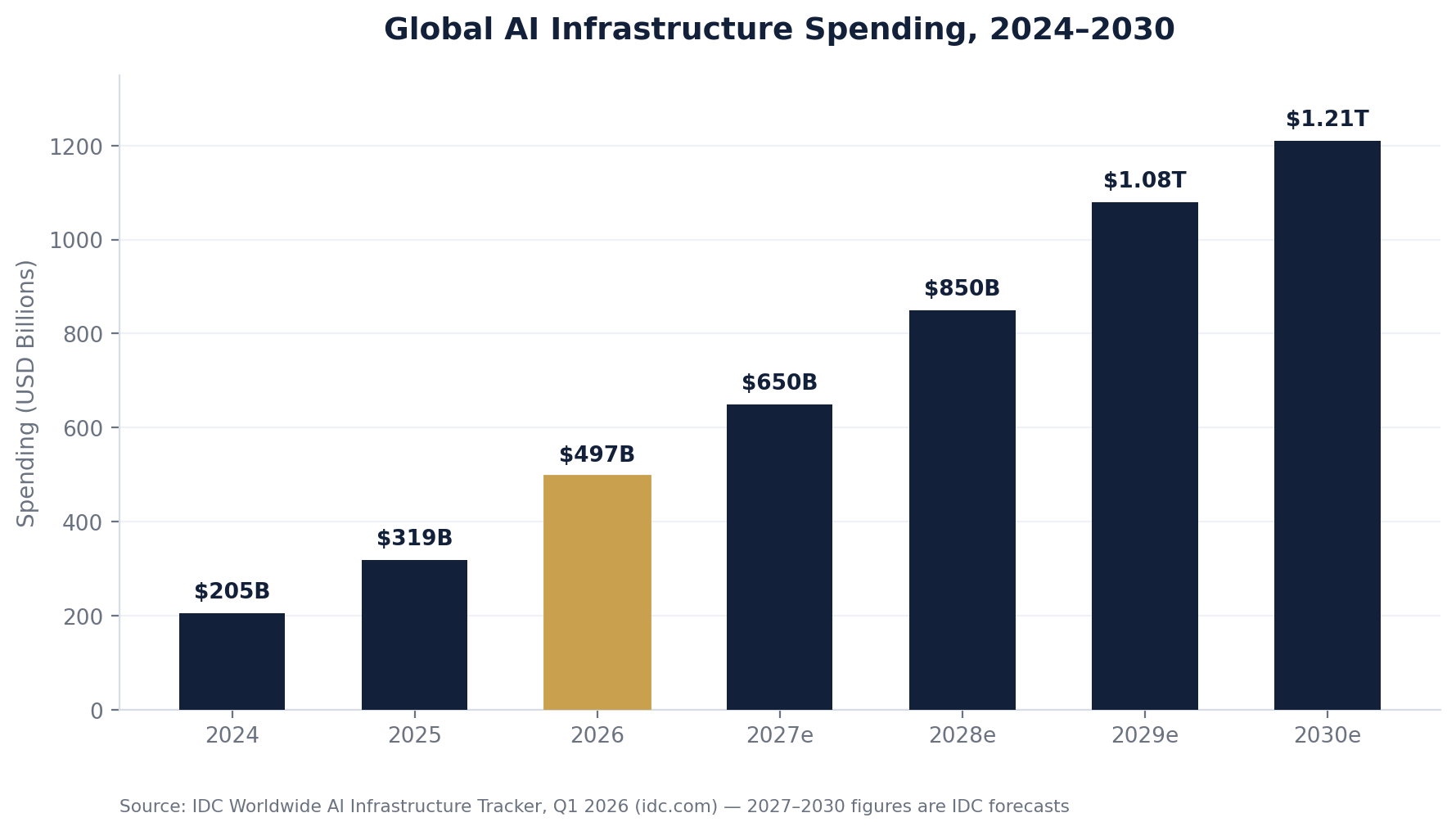
*Alt text: Bar chart of global AI infrastructure spending 2024–2030 in USD billions, based on IDC data*
That’s the money side. The harder question is what’s actually working once the invoice is due. Ten shifts answer that question for 2026 — some are already paying for themselves, a few are still mostly marketing, and one or two will quietly separate the companies that scale AI from the ones re-doing the same pilot every year.
Agentic AI means the system doesn’t just answer a prompt — it plans a sequence of steps, calls tools or APIs, checks its own output, and retries when something fails. In 2026, that idea finally has real deployment numbers behind it, and they tell an uneven story.
Gartner’s Q1 2026 survey found that **80% of enterprise applications** shipped or updated that quarter embed at least one AI agent, up from 33% in 2024.³ But intent isn’t production. McKinsey’s parallel research shows only **23% of organizations have scaled an agentic system** into live use, while another 39% are still experimenting.⁴ Gartner is blunt about where this heads: it expects **more than 40% of agentic AI projects to be cancelled by the end of 2027**, mostly because of unclear business value and thin risk controls.⁵
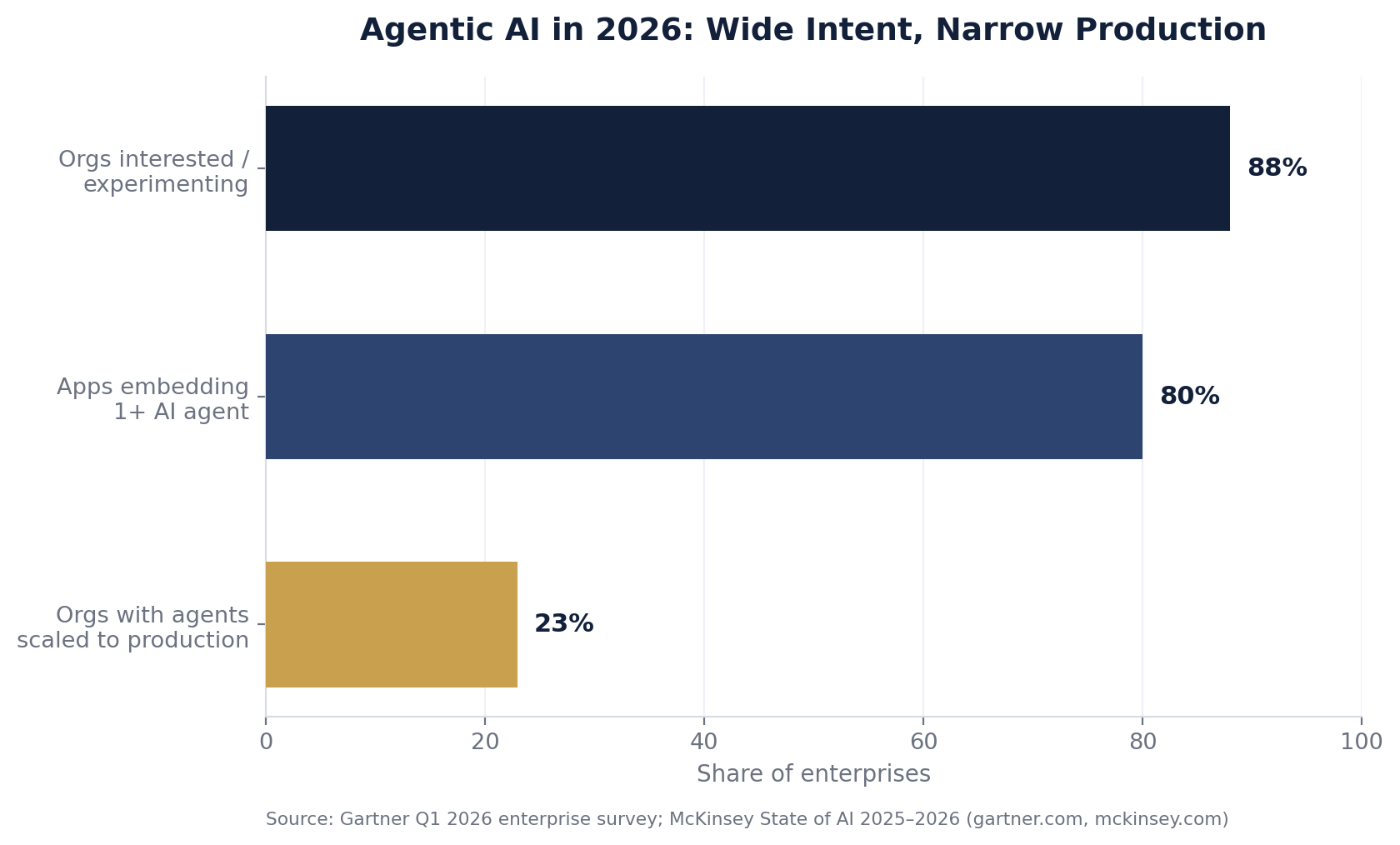

*Alt text: Chart showing the gap between agentic AI adoption intent and production use in 2026*
**What separates the 23% that scaled from the rest:** narrow scope. The agent deployments that survive contact with production are the boring ones — ticket triage, invoice matching, CRM data entry, claims intake — with tight permissions and a human checkpoint on anything that spends money, changes a record, or contacts a customer. The teams that tried to build one agent that “does everything” are the ones feeding Gartner’s cancellation statistic.
If you’re scoping this, our [AI development](https://www.arkasoftwares.com/artificial-intelligence) team treats agent permissions the same way we treat API access — least privilege by default, logged by default.
Generative AI in 2026 isn’t a novelty chat window anymore — it’s infrastructure. Teams pick a foundation model the way they’d pick a database, then build workflows on top of it.
Two shifts matter most this year. First, multimodal is now the baseline, not the premium tier — leading models handle text, image, audio, and increasingly video within a single call, which collapses what used to be three separate integrations (transcription, OCR, image generation) into one. Second, models are becoming better at structured tool use: calling functions, querying a database, and writing results back, rather than just describing what a human should do next.
The commercial upside is concentrated in a handful of high-volume, low-glamour tasks: first-draft support replies, sales follow-up sequencing, internal documentation Q&A, and turning a call transcript into a structured summary. None of that reads as exciting in a board deck, but it’s where the ROI numbers actually hold up — IDC and Microsoft’s joint research puts average generative AI return at **3.7x per dollar invested**, even though IBM’s 2025 CEO study found only 25% of AI initiatives hit their expected ROI.⁶ The gap between those two numbers is almost always scope: broad “transform the company” initiatives underperform, narrow high-frequency ones don’t.
More people can now build an AI feature without an ML team: document search, ticket sorting, call summarization, basic forecasting, all assembled from pre-built blocks (embeddings, speech-to-text, model APIs) rather than trained from scratch.
That’s genuinely useful for speed. It also creates what’s sometimes called shadow AI — a marketing intern wiring a public LLM API into a spreadsheet full of customer data, with nobody from security in the loop. The fix isn’t banning no-code tools; it’s setting three rules before anyone touches them: which data can go into a third-party model, where outputs are allowed to land, and which outputs need human sign-off before they reach a customer.
Edge AI runs inference on the device itself — a phone, a sensor, a piece of factory equipment — instead of round-tripping every request to the cloud. The appeal is straightforward: lower latency, data that never leaves the device, and a cloud bill that doesn’t scale linearly with usage.
In practice this shows up as: wake-word detection and offline translation running locally on phones and wearables; anomaly detection on low-power industrial sensors without a constant cloud connection; and faster reaction times for anything safety-critical, like warehouse robotics or medical devices, where a network hiccup isn’t acceptable.
The catch is real hardware constraints — battery, heat, memory — which forces teams toward smaller, quantized models and careful scheduling instead of just shrinking a cloud model and hoping. If your product roadmap includes a mobile or IoT component, this is usually a two-sided build: the on-device model and the backend that monitors and updates it, which is where a lot of teams underestimate the actual engineering lift.
This trend reads like paperwork because it is paperwork — but it’s the paperwork that gets an AI project past legal, security, and an enterprise procurement team.
The clearest deadline on the calendar: the EU AI Act’s transparency obligations (Article 50) and the European Commission’s enforcement powers over general-purpose AI models take effect on August 2, 202 .⁷ Note the nuance — the Digital Omnibus amendments passed in June 2026 pushed the *high-risk system* obligations out to December 2027, but transparency duties and GPAI enforcement were left untouched and land on schedule.
Companies serving EU users through a chatbot, AI-generated marketing content, or AI-driven product recommendations are inside scope regardless of where the company itself is based.
Beyond the EU, governance is consolidating around a few reference points that keep showing up in vendor security reviews: NIST’s AI Risk Management Framework as a shared vocabulary for risk and testing, and ISO/IEC 42001 as an auditable management-system standard for how an organization runs AI end to end. None of this is exciting, but it’s increasingly the difference between a signed contract and a stalled one.
AI inference is expensive to run at scale, and that cost is now a first-class design constraint rather than an afterthought for the sustainability report.
Power and cooling capacity are starting to limit what teams can actually deploy, which is why pruning, quantization, and model distillation moved from “nice academic technique” to “how we hit our unit economics.”
The honest read: most teams aren’t doing this because it’s green. They’re doing it because a model that costs less per inference ships faster, survives a pricing review, and stays in production longer. That’s still a win, whatever the motivation.
 https://www.arkasoftwares.com/contact-us
This is arguably the most commercially important shift for 2026: companies are moving away from buying a generic “AI platform” and toward narrow tools built for one workflow inside one industry. A tool that does one part of a specific job well outperforms a broad assistant that does everything shallowly.
AI takes on note drafting, document sorting, and pulling key facts out of a patient’s history — administrative load, not diagnosis. Clinicians keep making the calls; the win is more time in the room with a patient and less time reformatting notes.
AI flags unusual transactions, sorts incoming documents, and shrinks the manual review pile. Banking and insurance currently lead all industries in agent deployment, with **47% of these organizations running at least one AI agent in production** versus 18% in healthcare and 14% in government, per S&P Global Market Intelligence and McKinsey.⁸
Product recommendation engines and demand forecasting are the two use cases with the clearest, most measurable revenue line — one Arka Softwares client saw a **34% lift in conversion rate within 90 days** after adding AI-driven product recommendations to a Shopify storefront.⁹
Route planning, delay prediction, and dispatch automation cut down on the “where is it?” phone calls in logistics; in real estate, AI increasingly handles lead scoring, listing description generation, and document review for closings.
The pattern across every vertical: the best use case is the one that happens often and causes friction every single time. If a task only comes up twice a month, AI is overkill — it becomes something else to maintain, not something that pays for itself.
AI is now on both sides of the security conversation. Defenders use machine-learning-based anomaly detection to spot unusual behavior across users, devices, and transactions faster than rules-based systems ever could. Attackers use the same category of tools to scale phishing and social engineering.
And if you’re the one building an AI application, the model itself is now part of what needs defending — against prompt injection, data poisoning, and attempts to manipulate outputs. NIST has published a full taxonomy of adversarial machine learning attacks and mitigations, which is a fair signal that this stopped being a niche academic concern.¹⁰ The practical rule for anything agentic: if it can take an action, log it, gate it, and treat it like a security-relevant system — because it is one.
Most companies don’t want AI to replace a role — they want it to absorb the repetitive 40% of a job so a skilled person can spend more time on the 60% that needs judgment. That’s less exciting than a replacement narrative, but it’s what’s actually driving adoption inside teams.
Where it holds up in practice: first-draft generation for routine writing, document summarization, and turning scattered notes or chat threads into a structured task list. Adoption climbs fastest when AI sits inside a tool people already use daily — a CRM, a helpdesk, a code editor — rather than living in a separate prompt window nobody remembers to open. The one rule worth enforcing everywhere: AI takes the first pass, a human signs off on anything where a mistake would actually cost money or trust.
A handful of technologies are moving from research paper to real engineering work, even if they’re not mainstream yet:
The technology moves fast; the underlying skill set is more stable than the hype suggests:
Three practical filters, based on what’s actually separating the AI projects that ship from the ones that quietly die in a backlog:
1. Pick a problem that happens often and hurts a little every time it does. High-frequency, well-defined, and measurable beats broad and ambitious.
2. Scope the agent narrowly and log everything.** One workflow, tight permissions, a human checkpoint on anything that spends money or touches a customer.
3. Treat governance as part of the build, not a step after launch.If EU users are anywhere near your product, the compliance clock is already running.
If you’re weighing whether to build this in-house, hire it out, or run a scoped pilot first, that’s exactly the kind of conversation our [AI consulting] team has with clients before any code gets written — mapping the actual workflow, the data you have versus the data you’d need, and where a narrow AI agent or generative feature would earn its keep inside your product.
AI in 2026 isn’t about chasing the newest model release — it’s about picking a small number of high-frequency problems, connecting AI to real data and real tools, and putting guardrails around anything that can spend money, touch a customer, or move data it shouldn’t. The companies pulling ahead this year aren’t the ones with the biggest AI budget. They’re the ones treating AI like software: scoped, tested, monitored, and accountable to someone.
Agentic AI — systems that plan multi-step actions and use tools rather than just answering prompts — is the single most-discussed shift in 2026, though production deployment (23% of organizations, per McKinsey) still trails far behind experimentation and interest (88%)
It’s still growing, but the growth is in depth rather than novelty. Multimodal capability (text, image, audio, video in one model) and tool-calling are now standard rather than premium features, and the commercial value has shifted toward high-volume, narrow tasks like support drafting and document summarization.
Banking and insurance lead, with 47% of organizations in those sectors running at least one AI agent in production, compared with 18% in healthcare and 14% in government, according to S&P Global Market Intelligence and McKinsey’s 2026 data.
It depends on whether the workflow is a genuine differentiator or a commodity process. Off-the-shelf tools work well for common, well-understood tasks (support triage, basic forecasting); a custom build makes sense when the workflow is specific enough to your business that no generic tool fits it without heavy workarounds.


Jeeto11
The app quickly earned over 1,000 downloads within two months of launch, and users have responded positively. ARKA Softwares boasted experienced resources who were happy to share their knowledge with the internal team.

Archithrones
While the development is ongoing, the client is pleased with the work thus far, which has met expectations. ARKA Softwares puts the needs of the client first, remaining open to feedback on their work. Their team is adaptable, responsive, and hard-working.

Service Provider
I started my project with Arka Softwares because it is a reputed company. And when I started working with them for my project, I found out that they have everything essential for my work. The app is still under development and but quite confident and it will turn out to be the best.