Key takeaways
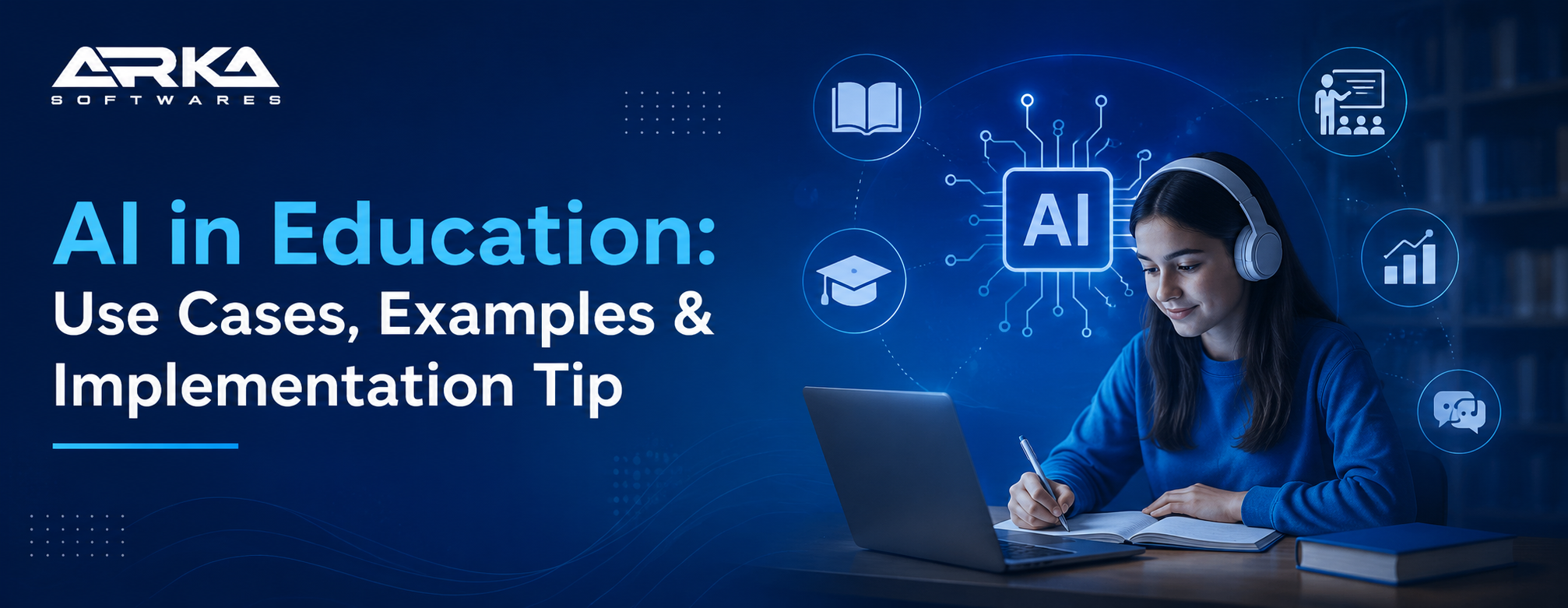
Artificial intelligence in education is being used to improve learning outcomes and give teachers better tools to do their jobs — not replace them. From automated assignment grading to adaptive, student-specific curricula, there are already dozens of proven ways AI can be applied inside a school or university.
AI has the potential to shift education away from rote memorization and toward something closer to mastery-based, personalized learning — helping each student build the specific skills they’re missing instead of moving everyone through the same material at the same pace.
As the technology matures, institutions are increasingly turning to custom AI software development to actually deploy these tools inside their classrooms and LMS platforms, rather than relying on one-size-fits-all SaaS.
25.9% the expected global AI-in-education market CAGR, 2026–2033 — Grand View Research 60% of K-12 teachers used an AI tool for work during the 2024–25 school year — Gallup / Walton Family Foundation 26% of U.S. teens say chatbots are extremely or very helpful for schoolwork — Pew Research Center
AI in education covers any system that uses machine learning, natural language processing, or predictive analytics to personalize learning, automate academic or administrative work, or surface insights schools can act on. That’s a wide net — it includes an adaptive math platform that resequences lessons based on a student’s error patterns, a chatbot that answers financial-aid questions at 11 p.m., and a dropout-prediction model flagging a student’s attendance drop before a counselor would notice it manually.
The distinction that matters for anyone planning a build: some of this is off-the-shelf SaaS (Khanmigo, Duolingo Max), and some of it has to be custom — because your student information system, your grading policies, or your compliance requirements don’t match what a generic tool assumes. Knowing which is which before you scope a project saves months.
AI platforms track how a student interacts with material — which problems they get wrong, how long they take, where they abandon a lesson — and adjust the difficulty and sequence in real time.
A student stuck on algebra gets the concept broken into smaller steps before moving on, instead of being pushed forward on a fixed schedule. This is the single most-cited use case across EdTech vendors because it’s the one closest to the original promise of AI in education: instruction that adapts to the learner instead of the other way around.
Conversational AI tutors don’t just hand out answers — the better ones (Khanmigo is the reference example) use Socratic questioning to walk a student toward the solution, which is a meaningfully different design problem than a standard chatbot.
Built well, these systems give students unlimited practice without the scheduling and cost constraints of a human tutor, and they’re available at 2 a.m. before an exam, which is when a lot of studying actually happens.
Machine learning and LLM-based grading handles multiple-choice and short-answer assessment at scale, and increasingly gives structured feedback on writing — coherence, argument strength, grammar — not just a score.
Teachers surveyed by RAND report saving close to six hours a week once generative AI is part of their grading and lesson-prep workflow. That time doesn’t disappear; the better-run institutions redirect it into one-on-one mentoring and lesson design, which is where teachers actually move the needle.
Course registration questions, financial aid deadlines, campus logistics — a large share of what admissions and student services staff field is repetitive and time-sensitive. AI chatbots handle it around the clock and scale to thousands of simultaneous conversations without the response-time cliff that hits during peak enrollment.
Georgia State University’s “Pounce” chatbot is the most-cited case study here for a reason: it reduced summer melt (admitted students who never show up in the fall) by over 20% just by nudging students through the paperwork they were stalling on.
Predictive models trained on attendance, grades, and engagement data can flag students likely to fall behind or leave before a human advisor would catch it from a spreadsheet. This only works if the institution commits to acting on the flag — a prediction with no intervention workflow behind it is just a dashboard nobody opens.
AI tools analyze aggregate student performance and engagement data to show curriculum designers which units are underperforming, which explanations aren’t landing, and where the material is out of step with what students actually need. This is a slower-burn use case than the student-facing ones, but it compounds — better curriculum data each term means better decisions the next term.
Text-to-speech, speech-to-text, real-time captioning, and AAC-style communication support give students with visual, hearing, or motor impairments a materially better shot at full classroom participation. This is one of the few AI use cases in education where the ROI case doesn’t need much defending — it’s closer to a compliance and equity obligation than an optimization.
AI conversation partners simulate native-speaker interaction without the scheduling limits of a human conversation partner. Duolingo Max’s roleplay feature — practicing a coffee order or a travel scenario with an AI character that adjusts to skill level — is the clearest example of how this moves language practice from passive drilling to something closer to actual use.
AI-driven screening and support tools give students a lower-friction first point of contact for mild anxiety or stress, which frees campus counseling capacity for students who need in-person care. This one needs the most caution of any use case on this list — it has to be built with clinical oversight and a clear, fast handoff path to a human when a conversation moves beyond what a chatbot should be handling.
Beyond the classroom, AI streamlines the unglamorous but expensive side of running a school: food service quantities, facility scheduling, staffing forecasts, procurement timing. It’s rarely the headline use case in a vendor pitch, but it’s often where the operating-cost savings are largest and least visible.
| Platform / Institution | What It Does | Result Worth Noting |
|---|---|---|
| Khan Academy — Khanmigo | GPT-4-based AI tutor and teaching assistant for students, teachers, and parents. | Piloted across hundreds of US school districts and rated above several general-purpose AI tools by Common Sense Media. |
| Duolingo / Duolingo Max | Adaptive language learning with AI-powered roleplay and conversation practice. | Personalizes learning at the scale of hundreds of millions of users using daily exercise data. |
| Georgia State University — Pounce | AI chatbot for admissions, enrollment, and student support. | Cut summer melt by over 20% and reduced withdrawals tied to outstanding balances by roughly half. |
| Carnegie Learning — Cognitive Tutor | Adaptive AI learning software designed for K-12 math education. | Adjusts the teaching approach for each student and gives teachers a real-time feedback loop on progress. |
| University of Calgary — T-Rex Chatbot | Library research assistant combining an LLM with retrieval over the library’s own content. | Answers roughly half of incoming questions, freeing staff time for higher-value research support. |
The pattern across every credible example: the win isn’t “we added AI.” It’s a specific, measurable problem — melt, grading backlog, after-hours support gaps — matched to a narrow AI solution built or configured for that exact workflow.
get a learning experience that adjusts to their pace, instant feedback that shortens the loop between mistake and correction, and support available outside office hours — which matters most for working students, international students, and anyone who studies at odd hours.
et hours back from grading and admin work, better visibility into which students are struggling before it shows up in a final grade, and data to back up decisions that used to be gut calls.
get more frequent, more specific updates on their child’s progress instead of waiting for a report card or a parent-teacher conference to find out something’s off.
get faster, better-informed decisions on enrollment trends and resource allocation, lower administrative overhead per student served, and — when it’s done right — better staff retention, because less of the job is repetitive paperwork.
Increasingly these run on a hybrid stack — a general-purpose LLM handles the conversational layer, while proprietary logic (built by the institution’s development partner) handles the domain-specific rules: grading policy, accommodation requirements, FERPA-compliant data handling.
That hybrid pattern is where most custom EdTech development work now actually sits.
| Challenge | Practical Fix |
|---|---|
| Student Data Privacy (FERPA, GDPR) | Implement a data governance framework, encryption, anonymization for any locally trained models, and strict vendor data-processing agreements. |
| High Upfront Cost | Start with a scoped pilot instead of an institution-wide rollout. Use SaaS for commodity use cases and custom-build only where a generic tool genuinely does not fit. |
| Staff Lacking AI Literacy | Provide structured training tied to real workflows rather than relying on a one-off orientation session. |
| Generative AI Misuse by Students | Combine plagiarism-detection tools with a shift toward oral assessments and in-class writing rather than an outright ban, which can simply push AI usage underground. |
| Measuring Actual Impact | Define the success metric before the pilot starts. Outcome data collected after the fact is far weaker evidence than a predefined target tracked from day one. |
AI is shifting education from fixed-pace, one-size-fits-all instruction toward personalized learning paths, automated assessment, and data-backed decisions on curriculum and student support — while taking a meaningful share of administrative work off teachers’ plates.
It depends heavily on scope — a single-purpose chatbot integrated with an existing LMS costs far less than an adaptive learning platform built from scratch. The honest starting point is a scoping conversation that maps your specific use case, data sources, and integration requirements before anyone commits to a number.
Use SaaS for commodity problems a generic tool already solves well (language practice, basic chat support). Build custom where your grading policy, compliance requirements, or existing systems don’t match what an off-the-shelf tool assumes — which, in higher ed and K-12, is more often than vendors like to admit.


Jeeto11
The app quickly earned over 1,000 downloads within two months of launch, and users have responded positively. ARKA Softwares boasted experienced resources who were happy to share their knowledge with the internal team.

Archithrones
While the development is ongoing, the client is pleased with the work thus far, which has met expectations. ARKA Softwares puts the needs of the client first, remaining open to feedback on their work. Their team is adaptable, responsive, and hard-working.

Service Provider
I started my project with Arka Softwares because it is a reputed company. And when I started working with them for my project, I found out that they have everything essential for my work. The app is still under development and but quite confident and it will turn out to be the best.