

Key Takeaways
Most companies asking about AI agent development cost have already tried the free version of the answer — a ChatGPT wrapper someone on the team built over a weekend. It worked, for a while, until it needed to actually take actions in a real system instead of just answering questions, and the weekend project hit a wall. That’s usually the point where “how much would it cost to do this properly” turns into a real budget conversation.
Here’s the honest range: a single-purpose AI agent runs $5,000–$25,000 to build; a custom agent with real integrations runs $25,000–$100,000+; a multi-agent system orchestrating several specialized agents across an enterprise stack can run $100,000–$400,000+. Almost nobody needs the top of that range on their first project.
Quick answer: Most businesses building their first production AI agent should budget $25,000–$80,000 for the build, plus $500–$5,000/month to run and maintain it. Multi-agent orchestration and heavy compliance requirements push costs well past that — simple single-task automation costs less.
Two Gartner predictions are worth holding in your head at the same time. The first: 33% of enterprise software applications will embed agentic AI by 2028, up from less than 1% today. The second: more than 40% of agentic AI projects will be canceled by the end of 2027 — killed by rising costs, unclear business value, or inadequate risk controls.
Both are true, and together they describe this market better than any vendor pitch: the category is real and compounding, and a large share of the money currently flowing into it is being spent badly. Gartner’s researchers also estimate that of the thousands of vendors claiming to sell AI agents, only around 130 offer genuinely agentic capabilities — the rest are rebranding existing automation, a practice they’ve labeled “agent washing.”
The rest of this guide is, in practice, a set of tools for staying on the right side of those two numbers.
“AI agent” gets used for three genuinely different things, and the cost difference between them is enormous:
The mistake we see most often isn’t picking the wrong price tier — it’s skipping straight to a multi-agent architecture for a problem a single well-built agent would have solved for a fifth of the cost.

| Approach | Typical build cost | Typical timeline | Ongoing cost |
| Low-code / platform-based | $5,000–$15,000 | 2–4 weeks | $300–$800/mo |
| Custom single-purpose agent | $25,000–$100,000 | 6–12 weeks | $500–$3,000/mo |
| Multi-agent orchestration | $100,000–$400,000+ | 3–6 months | $2,000–$10,000+/mo |
Treat these as planning estimates, not fixed quotes — the actual number depends heavily on how many existing systems the agent needs to integrate with and how much human-review tooling you need around it.
One number that surprises most first-time buyers: total first-year cost of ownership — infrastructure, monitoring, prompt/model maintenance as things drift — typically runs 40–80% higher than the initial build cost. A vendor who only quotes the build, not the first year, is quoting you half the number.

Four things explain most of the spread between a $15,000 quote and a $150,000 quote:
Worth saying plainly: a vendor who wants to sell you a multi-agent system before scoping whether your problem needs one is optimizing for their invoice, not your outcome. Anthropic’s own engineering guidance on building agents makes the same point — the simplest workflow that reliably solves the problem usually beats a more complex agentic system, and that’s coming from a company that builds the models these agents run on.
The build cost above buys a process, not just code. Five stages, in the order that keeps risk cheap:
Pick one process. Quantify what it costs to do manually today — hours, error rate, delay. If that number can’t be established, stop here; an agent whose ROI can’t be measured will be one of Gartner’s canceled projects. Sequencing this properly is roadmap work, not engineering work, and it’s cheap compared to building the wrong thing.
The agent needs API access to the systems it reads from and acts on. If the critical data lives in someone’s head or an unmaintained spreadsheet, that’s the project — fix the data problem first, at data-problem prices.
Two to four weeks, real data, every consequential action gated behind human approval. The goal is cheap disproof: if the agent can’t handle your real inputs at this stage, you’ve spent a fraction of the budget finding out.
The expensive middle: write-access to production systems, rollback paths, audit logging, and adversarial testing. This is where our quality engineering team earns its line item — an agent that acts on your CRM gets tested like software that acts on your CRM, because that’s what it is.
Ship to a slice of real traffic and watch the three numbers that matter: task completion rate, human-override frequency, and cost per resolved task. From there it either scales up or rolls into ongoing support for tuning as your data and processes drift.
The stack below is what most custom single-purpose builds standardize on in 2026. Treat it as a strong default, not gospel — the right answer always starts from the systems you already run.
| Component | Recommended |
| Primary models | Claude, GPT, or Gemini — chosen per task, not by default |
| Cost control | Smaller models for routine steps, a stronger model only where reasoning matters |
| Layer | Recommended |
| Custom orchestration | LangGraph, LlamaIndex, or a plain typed workflow — simplest that works |
| Low-code platforms | n8n, Voiceflow, Botpress (the $5K–$15K tier above) |
| Layer | Recommended |
| Backend & APIs | Python (FastAPI), Node.js, REST/webhooks into your CRM and internal tools |
| Guardrails | Human-approval queues, audit logging, role-based access to every write action |
| Observability | LangSmith or Langfuse for traces, plus cost-per-task dashboards |
Notice what’s not on the list: a proprietary “agent platform” you can only rent from the vendor building yours. That’s the agent-washing pattern from the market section wearing an architecture diagram.
It tends to make sense when at least two of these are true:
If none of those apply, you probably don’t need an agent yet — a simpler automation or a better dashboard usually solves the actual problem for a fraction of the cost.
Considering a broader AI initiative rather than one agent? It’s worth scoping the whole roadmap first — our team can walk through where agentic AI genuinely fits versus where it doesn’t, before you commit budget to either.
This is the decision that actually precedes the pricing question for a lot of buyers:
| AI agent | Traditional automation (RPA/scripts) | |
| Best for | Tasks requiring judgment on unstructured input (emails, documents, ambiguous requests) | Rule-based, structured, repetitive tasks with clearly defined logic |
| Typical cost | $25,000–$100,000+ for a custom build | $5,000–$40,000 depending on complexity |
| Maintenance | Ongoing monitoring for model drift and edge cases | Lower once rules are stable, but brittle to process changes |
Most businesses end up needing both, not one or the other — agents for the ambiguous, judgment-heavy steps, and conventional automation for everything with a clear, stable rule underneath it.
Google Cloud’s architecture guidance for AI/ML systems is a reasonable baseline for sanity-checking a vendor’s proposed approach, particularly around how they plan to monitor the system once it’s live — that’s the part most first-time buyers forget to ask about. A good engagement should tell you, before you sign, how it will measure whether the agent is actually working: task completion rate, human-override frequency, and cost-per-resolved-task are the three that matter most.
We’ve written before about where agentic AI is heading for business workflows, and about how startups specifically should approach AI investment — both are worth reading alongside this if you’re still deciding whether to build now or wait.
Here’s the checkable version, since “we’re passionate about AI innovation” tells you nothing.
Arka’s AI agent engagements default to the smallest build that proves ROI — a single well-scoped agent in the $25,000–$50,000 band, human-in-the-loop from day one — and we’ll say so when a problem doesn’t need an agent at all, because a workflow with two LLM calls in it is often the honest answer. The same engineering team covers the surrounding work (data pipelines, integrations, model selection), so “the data isn’t ready” is a phase in the project, not a reason to bill you twice.
If a vendor you’re comparing us against quotes a multi-agent system in the first call, ask them which of the five stages above they’re planning to skip.
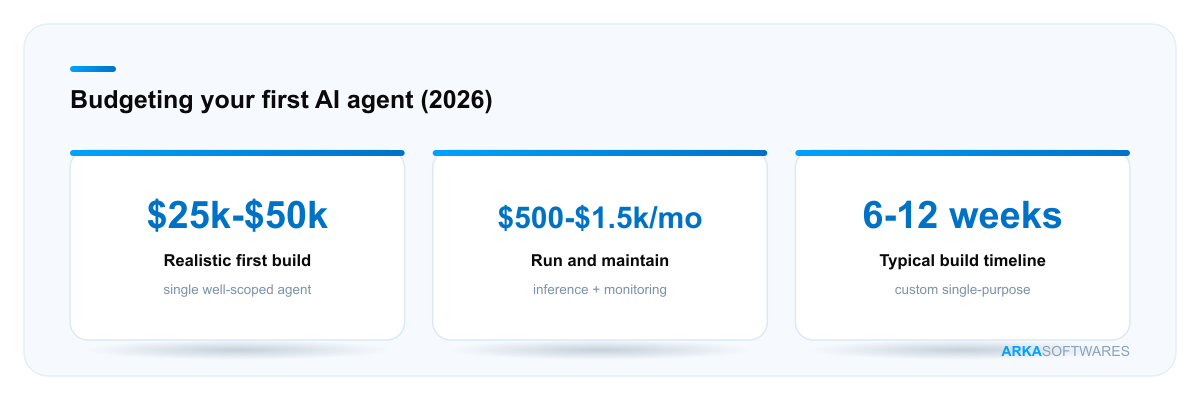
If this is a first project, a realistic starting budget is $25,000–$50,000 for a single well-scoped custom agent, focused on one process with clear ROI, plus $500–$1,500/month to run and maintain it. That’s enough to prove the approach works before committing to a larger multi-agent build.
The AI agent market rewards the same buyer behavior it punishes vendors for skipping: scope one process, price the full first year, keep a human in the loop until the numbers say otherwise. Do that, and the wide cost ranges in this guide collapse into a number you can actually plan around — and you stay out of the canceled-project statistics from the market section.
Arka’s AI agent development team scopes engagements this way by default, and our broader AI development practice covers the surrounding work (data pipelines, model selection, integration) when a project needs more than just the agent itself. If you’d rather skip the range and get an actual number, the fastest path is to book a 20-minute scoping call — come with the specific process you want automated and we’ll tell you which pricing tier it actually falls into.
A low-code agent built on a platform like Voiceflow or n8n typically runs $5,000–$15,000, plus $300–$800/month to operate.
It’s worth it once a specific, repeatable process is costing more in manual labor than the build would cost to recover within 12–18 months — see the checklist above. Below that, a low-code agent or simpler automation is usually the better first step.
A chatbot answers questions. An agent takes actions — it can read data from your systems, make a decision, and trigger a real workflow (updating a record, sending an approval request, scheduling something) rather than just responding in a conversation.
A custom single-purpose agent typically takes 6–12 weeks. Multi-agent orchestration across multiple systems can take 3–6 months, largely driven by integration and testing time, not the AI model itself.
Budget $500–$5,000+/month depending on complexity, covering model inference costs, monitoring, and the periodic tuning needed as your underlying data or processes shift.


Jeeto11
The app quickly earned over 1,000 downloads within two months of launch, and users have responded positively. ARKA Softwares boasted experienced resources who were happy to share their knowledge with the internal team.

Archithrones
While the development is ongoing, the client is pleased with the work thus far, which has met expectations. ARKA Softwares puts the needs of the client first, remaining open to feedback on their work. Their team is adaptable, responsive, and hard-working.

Service Provider
I started my project with Arka Softwares because it is a reputed company. And when I started working with them for my project, I found out that they have everything essential for my work. The app is still under development and but quite confident and it will turn out to be the best.