Key Takeways
You open Spotify, tap a song, and it plays instantly. No buffering, no downloads, no friction, just music. Behind that seamless experience is a highly complex, expensive, and carefully engineered product that took years and millions of dollars to build.
Now you want to build something like it. The question is how much it will actually cost to develop a music streaming app?
The music streaming app development costs typically range from $15,000 for a basic MVP to $250,000+ for a full-featured platform.
Music streaming app development is not like building a standard mobile app. It involves audio infrastructure, music licensing deals, AI-powered recommendations, real-time syncing, and cross-platform compatibility, all working together without a hiccup. Miss one piece, and your users will notice immediately.
The good news? You don’t need Spotify’s budget to enter this market. Whether you’re a startup validating a niche idea, a business targeting regional audiences, or an entrepreneur building for independent artists, there’s a version of this product that fits your goals and your budget.
The global music streaming market hit $47 billion in 2025 and isn’t slowing down. Spotify crossed 600 million users. Apple Music, Tidal, and Amazon Music are each carving out serious subscriber bases.
And somewhere in between all of that, a growing number of founders and product teams are asking a very straightforward question: what would it cost to build something like this?
But that range isn’t very useful without context. The actual number you’ll spend depends on what you’re building, for which platforms, and with which team.
This guide breaks down every cost variable that matters: features, platform choice, tech stack, team structure, and post-launch expenses so you can walk into your first developer conversation with a realistic budget in mind.
It might seem like Spotify has already won. But the music streaming space is more fragmented than it looks from the outside. Niche platforms are growing fast, apps built around specific genres, regional music, independent artists, podcasts, wellness audio, and creator monetization are all finding audiences.
The business model has also matured. Freemium tiers, subscription plans, ad revenue sharing, artist merchandise integrations, and live audio features all give newer and top music streaming apps ways to generate revenue that didn’t exist a few years ago.
If you’re building something with a clear differentiation — whether that’s genre focus, audio quality, artist tools, or a specific community — there’s still a real market to capture.
The technology has gotten more accessible, too. Cloud audio infrastructure, open-source streaming tools, and AI-powered recommendation engines that would have cost millions to build in-house five years ago are now available as APIs. That changes the cost math significantly.
Before talking numbers, it’s worth clarifying what kind of music app you’re actually building. The category determines the core architecture, which is the biggest driver of development cost.
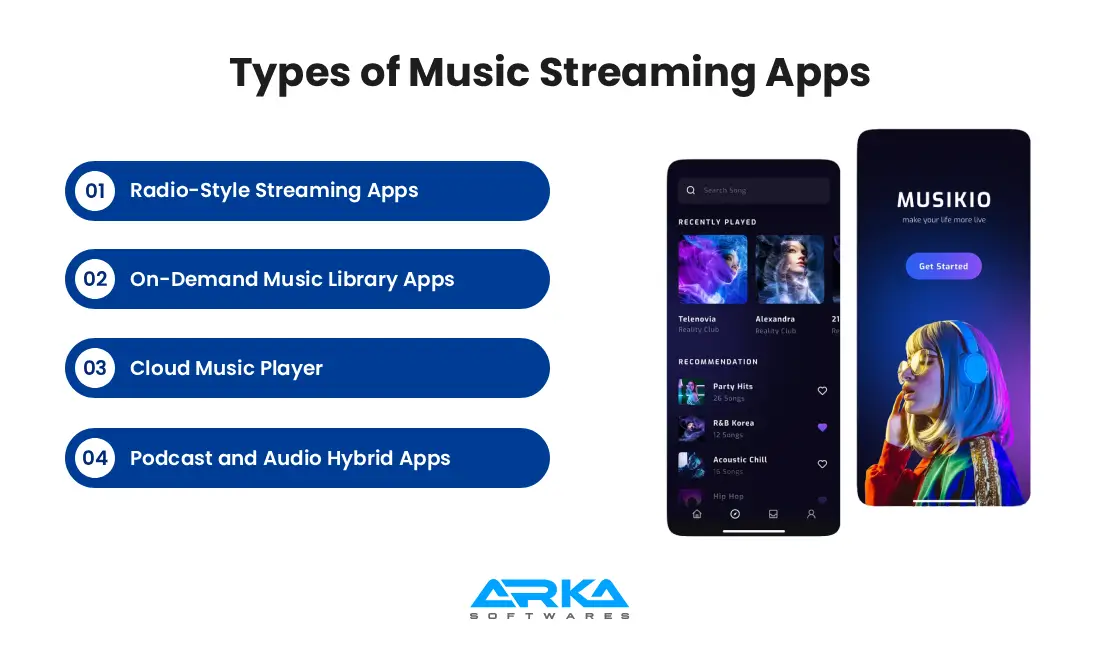
These serve pre-curated content to listeners without on-demand control. Think iHeartRadio or SiriusXM. Users tune into genre channels or artist stations; they don’t pick individual tracks.
The backend is simpler than on-demand platforms since you’re managing streams rather than individual playback requests. These typically land on the lower end of the cost scale.
This is the Spotify model. Users can search, select, and play any song from a catalog. They create playlists, save favorites, and get personalized recommendations.
This is significantly more complex to build — you need a real database of licensed tracks, a more sophisticated streaming backend, and recommendation logic. Most founders building a new streaming product are targeting this category.
These let users upload their own music collection and stream it across devices. Google Play Music was the best-known example before it was discontinued.
These apps tend to be cheaper to build since you don’t need to manage a licensed catalog, but they have limited commercial upside unless paired with other features.
Spotify absorbed this market by adding podcast support, but there’s still room for focused podcast + music hybrids, especially in the creator economy space. These require additional infrastructure for audio RSS feeds, episode management, and often transcription features.
Here’s a high-level view of what different levels of app complexity typically cost. These figures reflect US-based development rates in 2026.
| App Type | Estimated Cost | Timeline |
Best For |
| Basic MVP (limited features) | $15,000 – $60,000 | 2–4 months | Early validation, niche audiences |
| Mid-Level App (personalized streaming) | $70,000 – $150,000 | 4–8 months | Startups with a subscription model |
| Advanced Platform (full-featured) | $150,000 – $300,000+ | 8–14 months | Enterprise, Spotify-type products |
| Podcast + Music Hybrid | $80,000 – $130,000 | 5–9 months | Creator economy, audio brands |
These are ballpark estimates. Your actual cost depends on team location, feature scope, and whether you start cross-platform or native.
Features of the music streaming app are where most of your budget goes. Here’s a breakdown of what the major components cost to develop — whether you’re building them from scratch or integrating existing APIs.
Email signup, social login (Google, Apple, Facebook), and user profiles are table stakes. This is relatively straightforward work: $5,000–$10,000. If you’re adding social features like following artists or public playlists, add another $5,000–$8,000.
The core audio player — play, pause, skip, shuffle, repeat, crossfade — is more complex than it looks. You need codec support, audio buffering, gapless playback, and background audio handling across iOS and Android. Expect $12,000–$20,000 for a well-built player.
If you’re licensing a third-party catalog (via APIs like Napster, 7digital, or Gracenote), you avoid building a catalog from scratch but still need robust search, filtering, and display logic. This typically runs $10,000–$20,000, depending on the depth of metadata you’re surfacing.
Create, edit, and organize playlists. Save albums and songs. Sync across devices in real time. This is commonly underestimated — real-time syncing with cloud storage involves non-trivial backend work. Budget $10,000–$15,000.
This is one of the most significant cost variables. A basic recommendation system using collaborative filtering can be built for $15,000–$25,000.
A more sophisticated engine using neural networks and real-time behavioral data — the kind that powers Discover Weekly — can cost $40,000–$80,000 or more. For an MVP, start simple. You can improve the recommendation engine later.
Downloading tracks for offline playback requires DRM-protected local storage, background download management, and sync logic. If licensing allows for it, expect $15,000–$25,000 to implement this cleanly.
Shared playlists, following friends, activity feeds, and collaborative listening sessions are significant differentiators — but they’re also significant work. Social feature sets typically add $15,000–$30,000 to your build.
RSS feed ingestion, episode management, chapter markers, and playback speed controls. If you’re adding podcasts to a music app, budget an additional $20,000–$35,000.
You’ll need tools to manage content, users, subscriptions, and analytics. A basic admin dashboard runs $10,000–$20,000. A full content management system with artist tools and royalty tracking can run $30,000+.
| Feature | Estimated Cost |
| User Auth & Profiles | $5,000 – $10,000 |
| Audio Player & Playback Engine | $12,000 – $20,000 |
| Music Catalog & Search | $10,000 – $20,000 |
| Playlists & Library Sync | $10,000 – $15,000 |
| AI Recommendations (Basic) | $15,000 – $25,000 |
| AI Recommendations (Advanced) | $40,000 – $80,000 |
| Offline Downloads | $15,000 – $25,000 |
| Social Features | $15,000 – $30,000 |
| Podcast Support | $20,000 – $35,000 |
| Admin Dashboard | $10,000 – $20,000 |
Whether you build native (separate iOS and Android apps) or cross-platform (one codebase for both) is one of the biggest cost decisions you’ll make early on.
Native apps — Swift for iOS, Kotlin for Android — deliver the best performance and the tightest integration with platform features like background audio APIs, CarPlay, and Android Auto.
But you’re essentially building two apps. A native iOS music app alone runs $15,000–$65,000. Android runs similarly. Combined, expect $50,000–$130,000 just for the frontend.
React Native and Flutter let you write most of your code once and deploy to both platforms. For audio apps, the gap in performance versus native has narrowed significantly.
Most startups building their first version choose this path. Cross-platform development typically costs 30–40% less, landing in the $15,000–$60,000 range for the frontend, depending on complexity.
Recommendation: Start cross-platform for your MVP. If the product gains traction, you can rebuild performance-critical components natively. This is what most successful audio startups do.
|
Platform |
Approach |
Estimated Cost |
| iOS Only | Swift / Xcode | $15,000 – $65,000 |
| Android Only | Kotlin / Android Studio | $20,000 – $65,000 |
| iOS + Android (Native) | Separate builds | $50,000 – $130,000 |
| Cross-Platform | React Native or Flutter | $15,000 – $60,000 |
Your technology choices affect both the build cost and the ongoing infrastructure spend. Here’s how the major components break down.
Node.js, Python (Django/FastAPI), or Go are common choices for the backend. The backend handles user accounts, playback queues, content delivery routing, and analytics. This is typically the largest single line item: $20,000–$80,000 depending on scale and complexity.
You’ll likely use a relational database (PostgreSQL) for user data and a search-optimized store (Elasticsearch or Algolia) for the music catalog.
A Redis cache layer helps with performance at scale. Budget $10,000–$30,000 for database architecture, plus $500–$3,000/month in ongoing cloud database costs.
Audio delivery at scale requires a CDN. AWS CloudFront, Cloudflare, or Akamai are the common choices. This is typically priced on usage — streaming 100TB/month runs roughly $8,000–$12,000 in CDN costs. At MVP scale (under 10,000 active users), expect $200–$800/month.
Audio files are large. A library of 1 million tracks at 320kbps Ogg/MP3 runs roughly 10–15TB. AWS S3 or Google Cloud Storage at scale is manageable around $250–$400/month per 10TB, but you need to factor this into long-term unit economics.
| Tech Component | Description | Estimated Cost |
| Backend Development | APIs, auth, business logic | $20,000 – $80,000 |
| Database Architecture | SQL + search + cache layers | $10,000 – $30,000 |
| Cloud Infrastructure Setup | AWS/GCP/Azure initial config | $5,000 – $15,000 |
| CDN (Ongoing) | Audio delivery per usage | $200 – $12,000/month |
| Cloud Storage (Ongoing) | Audio file hosting | $250 – $2,000/month |
| Streaming APIs / Music Catalog | 3rd-party music data | $5,000 – $20,000 |
Who builds your app matters as much as what you’re building. Here’s the typical team structure for a music streaming app and what different hiring models cost.
| Region | Hourly Rate | Full App Cost Impact |
| USA / Canada | $120 – $220/hr | High — $150,000+ for mid-level app |
| Western Europe | $80 – $140/hr | Medium-High — $100,000+ |
| Eastern Europe | $45 – $90/hr | Medium — $60,000 – $120,000 |
| Asia (India, SE Asia) | $25 – $55/hr | Low — $30,000 – $80,000 |
| Latin America | $40 – $80/hr | Medium — $50,000 – $100,000 |
Lower hourly rates don’t automatically mean lower total cost. Communication overhead, revision cycles, and quality issues on complex audio features can erase the savings quickly.
The best outcome is usually a mixed model, US-based product lead with an experienced offshore development team.
This is how budget typically gets allocated across the development lifecycle.
| Phase | % of Budget | Cost Range | What’s Included |
| Discovery & Design | 10–15% | $5,000 – $20,000 | Research, wireframes, UI mockups, and architecture planning |
| Core Development | 50–60% | $30,000 – $120,000 | Frontend, backend, APIs, audio player, integrations |
| QA & Testing | 15–20% | $8,000 – $30,000 | Audio latency, device testing, performance, security |
| Launch & Deployment | 5–10% | $3,000 – $15,000 | Store submissions, infrastructure provisioning, monitoring |
| Post-Launch Maintenance | 15–25%/yr | $10,000 – $50,000/yr | Bug fixes, OS updates, feature additions, model retraining |
Post-launch maintenance is the most commonly underbudgeted item. iOS and Android OS updates alone require ongoing attention. Factor in at least 15–20% of your initial build cost annually.
This is the part that surprises most first-time founders. Building the app is one thing. Getting the right to actually play music on it is another, and it’s a significant ongoing expense.
To legally stream music, you need licensing agreements with rights holders. That typically means deals with the major labels (Universal, Sony, Warner), independent distributors, and performance rights organizations (PROs) like ASCAP, BMI, and SESAC.
Negotiating these deals as a new entrant is both time-consuming and expensive.
Don’t skip legal review on licensing. An entertainment lawyer who understands streaming rights typically costs $300–$600/hour, but one missed licensing obligation can shut your app down entirely.
If you want to estimate your specific project more accurately, these are the variables that move the number most significantly.
Every feature you add has a cost. The most expensive add-ons are AI in music apps, recommendation engines, offline downloads, social features, and live audio. Being disciplined about your MVP scope is the single most effective way to control initial cost.
Building native for both iOS and Android roughly doubles your frontend development cost compared to cross-platform. For a first version, cross-platform with React Native or Flutter is almost always the right call.
A US-based team at $150/hour will build the same feature in the same number of hours as an Eastern European team at $60/hour. Your total cost difference on a 1,000-hour project is $90,000. The tradeoff is communication quality, time zone alignment, and the cost of managing quality remotely.
Audio apps live or die on their interface feel. Custom animations, a polished player UI, and thoughtful navigation cost more than a generic template build — typically $15,000–$30,000 for premium design work. But this investment directly affects retention.
DMCA compliance, GDPR data handling, and DRM-protected audio delivery add real cost to your build. Expect $10,000–$20,000 in additional development and legal overhead to get this right.
Supporting Hi-Res audio (like Tidal’s FLAC streams) requires additional codec support, higher bandwidth CDN costs, and larger storage infrastructure. If audio quality is your differentiator, it’s worth the investment — but it will add $15,000–$25,000 to your build.
There’s a right way and a wrong way to cut the budget. Here’s what works.
Define the minimum feature set that delivers real value to users and build that first. An MVP focused on core playback, search, and basic playlists can be built for $30,000–$60,000. Use real user feedback to decide what to build next, rather than building everything up front.
Don’t build a recommendation engine from scratch. Don’t build your own audio codec. Don’t build your own CDN. There are APIs and services for all of these. The cost of integration is always lower than the cost of building from scratch.
React Native and Flutter have matured significantly. Unless you have a specific performance requirement that demands native, cross-platform will give you a solid first version at a meaningfully lower cost.
AWS, GCP, and Azure all have managed audio streaming services, managed databases, and auto-scaling infrastructure. Using managed services instead of self-managed infrastructure reduces your DevOps overhead significantly — both in build cost and in ongoing maintenance.
Social features, podcast support, AI recommendations — build the core first, ship it, learn from users, then add layers. Phasing your roadmap lets you spread cost over time and prioritize features that actually drive retention.
Building a music streaming app in 2026 is more accessible than ever — the infrastructure is better, the tools are more capable, and the niche market opportunities are real.
But the costs are still high, and the biggest mistakes happen when founders underestimate the scope or skip planning on licensing and long-term infrastructure.
The most important decision you’ll make isn’t which feature to build first — it’s finding a reliable music streaming app development company that understands audio products, not just mobile apps in general.
The difference between a team that’s built a streaming product before and one that hasn’t shows up fast in the technical architecture decisions.
If you’re planning a music streaming app and want to understand what your specific requirements would cost, Arka Softwares team is happy to review your feature list and give you a realistic estimate. No generic quotes, just a breakdown that actually reflects what you’re building.
The cost to build a music streaming app typically ranges from $15,000 to $250,000+, depending on features, platform, and complexity. Additional ongoing expenses like music licensing, server maintenance, and updates can add $1,000–$10,000 per month post-launch.
A basic MVP takes 2–4 months. A mid-level app with recommendations and offline support takes 4–8 months. A full-featured platform takes 8–14 months. These timelines assume a focused team; part-time or fractional teams stretch them significantly.
Ongoing costs include cloud hosting ($500–$5,000/month, depending on scale), CDN delivery costs (usage-based), maintenance and development (15–20% of initial build cost annually), and licensing fees. Budget at least $15,000–$50,000/year for a modestly scaled product.
Yes, React Native is a good choice for music streaming apps as it handles background audio, media session controls, and CarPlay/Android Auto reasonably well. The performance gap with native has narrowed significantly. For a first product, cross-platform is the right choice. If you need extremely precise audio latency or high-res audio processing, native will eventually be worth the investment.
Yes. Audio streaming has specific backend requirements, chunked audio delivery, adaptive bitrate streaming, queue management, and caching that differ from standard API backends. Make sure your backend developer has experience with media delivery, not just general web services.
Start by defining your feature list and target platforms. Then get scoped estimates from experienced and top mobile app development companies with music or media app experience. Ask them to break the estimate down by feature so you can make tradeoff decisions. Flat-rate estimates without breakdowns are a red flag.


Jeeto11
The app quickly earned over 1,000 downloads within two months of launch, and users have responded positively. ARKA Softwares boasted experienced resources who were happy to share their knowledge with the internal team.

Archithrones
While the development is ongoing, the client is pleased with the work thus far, which has met expectations. ARKA Softwares puts the needs of the client first, remaining open to feedback on their work. Their team is adaptable, responsive, and hard-working.

Service Provider
I started my project with Arka Softwares because it is a reputed company. And when I started working with them for my project, I found out that they have everything essential for my work. The app is still under development and but quite confident and it will turn out to be the best.