
Fantasy sports have evolved from a simple points game to a real-time digital competition. Early platforms supported small leagues and delayed scoring. Modern apps must support millions of users. They must process live match events. They must update scores instantly. This shift makes fantasy sports engine architecture the backbone of success. A fantasy sports engine is no longer a feature. It is the core product. It determines scale, speed, fairness, and engagement.
Users expect real-time leaderboards. They expect secure wallet transactions. They expect fair contests without bots. Carriers of sports data must sync without delay. All of this depends on strong module design. It also depends on smart data flow.
A fantasy sports engine architecture connects multiple moving parts. These include contests, squads, scoring rules, fraud checks, and reward settlements. If one part fails, the entire contest experience suffers. Well-designed architecture reduces failure risk. It keeps the platform responsive. It helps engineering teams extend new game formats without rebuilding the core.
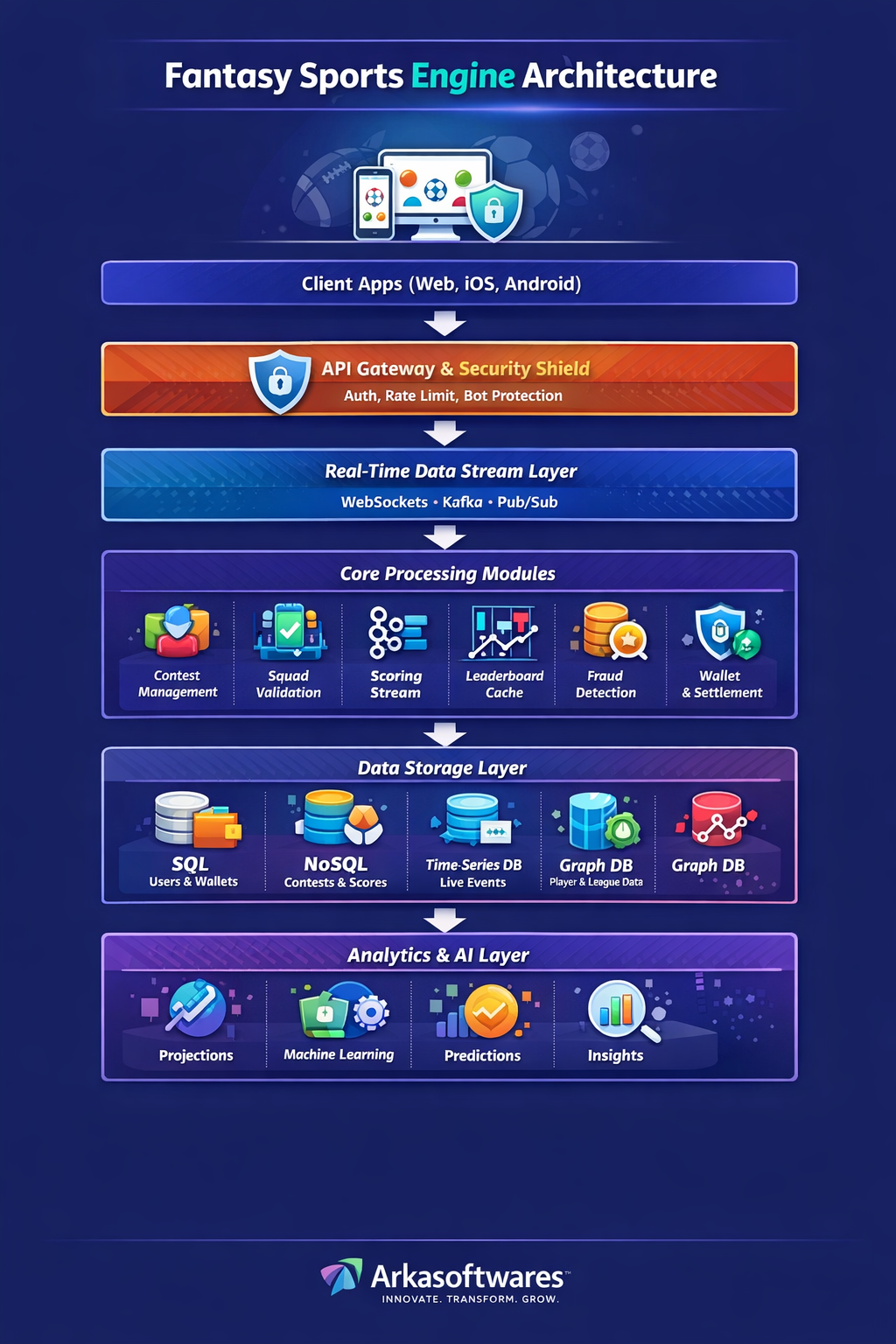
The high-level flow of a fantasy sports engine is simple to explain. The app collects users and contest entries. It ingests sports data feeds. It validates squads. It runs scoring rules. It updates leaderboards. It settles rewards into wallets. It stores analytics for future predictions. This loop runs continuously for every live match.
The system must respond in milliseconds. Every play event should reflect in user points quickly. Slow updates break engagement. Real-time responsiveness must extend across scoring, rankings, and alerts.
Modules must be independent. Teams should plug new contest formats easily. The engine should support cricket, football, basketball, and new fantasy variants. These modifications must happen without rewriting the core logic.
Contests run with money and user emotions at stake. Downtime is unacceptable. The engine must auto-recover from feed issues. It must fail-over between regions. It must serve traffic spikes safely.
Fantasy engines must balance speed and accuracy. Live scoring needs low latency. Wallet settlement needs strong consistency. Each module must apply the right balance based on criticality.
User data, wallet data, and contest logic must be secure. APIs must block bots. Fraud monitors must detect collusion. The system must log every contest action for audit trails.
A fantasy sports engine is best built using microservices or a hybrid approach. Pure monolithic systems fail at real-time scale. Pure microservices without orchestration create inconsistency. Hybrid engines balance both.
A hybrid model keeps core game state centralized. It keeps heavy processing distributed. Contest scoring runs on stream workers. Wallets run on consistent transactional services.
Every live match produces play events. These events must stream into the engine. Kafka or Pub/Sub systems distribute these events to scoring modules and fraud modules. This enables parallel processing.
The gateway routes all external requests. It rate-limits suspicious traffic. It handles authentication. It protects internal microservices from direct public exposure.
Caching is critical for leaderboards and player stats. In-memory caching reduces query load. Redis clusters store pre-computed rankings. CDNs serve static sports assets globally.
Fantasy engines need a streaming backbone. WebSockets update users in real time. Kafka workers process live play events. Pub/Sub distributes scoring and ranking triggers.
Databases are selected by module role:
This module manages users, profiles, contest creation, contest entry, and wallet linkage. It assigns users to contests. It stores roster ownership. It tracks salary caps. It links wallet balances to contest entry fees.
The service must validate contest eligibility. It must block duplicate contest joins. It must track multi-entry contests. It must expose APIs through the gateway only. This protects internal services from misuse.
Contest management also defines game types. It defines player limits. It defines draft or salary-based entries. It stores contest lifecycle states. These include open, live, closed, cancelled, or settled.
Data is stored in NoSQL for fast access. Wallet linkage uses SQL for consistency. This ensures money safety and user state accuracy.
This module builds leagues and tournaments. It supports public leagues. It supports private leagues. It supports knockout tournaments. It supports multi-match fantasy series.
Users can invite friends into leagues. Admins can configure tournament rules. Draft leagues can enable auction or snake drafts. Salary leagues can enforce budget caps. The builder must maintain league state as a graph. This helps match relationships cleanly.
Tournament graphs store connections between matches, squads, and league rankings. This supports season-long leaderboards. It also supports head-to-head progression.
This module ensures extensibility. New tournament formats can plug in without breaking scoring pipelines.
Fantasy engines rely on third-party sports data providers. These include live match feeds, historical stats, and projections. The ingestion layer pulls these feeds into an ETL pipeline. It cleans malformed records. It validates timestamps. It deduplicates events. It converts all feeds into a unified schema.
Normalization ensures every sport can share the same scoring engine. This reduces engineering complexity. It also improves consistency across contest formats.
Kafka workers stream play events into the scoring queue. Historical stats are stored in NoSQL. Telemetry is stored in time-series DB. Player correlations are stored in graph DB.
If feeds fail, the engine must retry. It must fallback to cached data. This ensures uptime and contest continuity.
This module stores and processes live and historical statistics. It tracks batting averages, goals, assists, rebounds, tackles, and defensive metrics. It stores player performance trends. It exposes data for projections and recommendations.
Stats are indexed by sport type and match ID. Caching improves speed for repeated queries. In-memory projections reduce load during live contests.
This engine powers captain suggestions. It powers expected points. It powers role-based player picks. It also supports analytics dashboards.
Data storage is mostly NoSQL for speed. Live events use time-series DB. Graph DB supports player-to-player relationship mapping.
This module validates squads before contests go live. It checks salary cap limits. It checks role limits. It checks duplicate players. It checks sport-specific constraints. It enables auto-pick for drafts. It enables auction picks. It enables player trades.
The validation engine rejects invalid squad submissions. It provides instant feedback to the app. It ensures every squad meets contest rules. This avoids unfair advantages.
Squad data is stored in NoSQL. Draft state uses a centralized state machine. This ensures predictable contest lifecycle transitions.
This is the most critical module. It calculates user points based on live match events. It applies sport-specific scoring rules. It applies multipliers. It applies bonus logic. It applies penalties. It processes every play event as a scoring trigger.
The engine supports rule pipelines. For example:
Scoring runs on Kafka stream workers. It processes events in parallel. This ensures low latency. It pushes calculated points into the leaderboard service instantly.
Bonus rules are abstracted into a rules engine. This makes new formats easy to support. Passive voice is avoided unless data integrity is being described.
This module processes live match state. It tracks play-by-play events. It converts them into scoring triggers. It pushes them into the stream layer. It ensures match clocks sync correctly. It validates event order. It avoids race conditions.
Stream workers update the scoring module. WebSockets update users. Cached match state protects from provider delay. This ensures instant fan impact.
The match processor also emits settlement triggers when contests close.
Leaderboards rank users globally and within contests. It supports tie-breakers. It sorts by points. It sorts by timestamps if needed. It caches pre-computed ranks. It serves rankings instantly through Redis or in-memory stores.
Leaderboards update from scoring stream workers. They do not query DB repeatedly. This reduces load. It protects contest engagement from slow queries.
Multi-region caches ensure global users see updates fast.
This is the AI/ML enhancement module. It predicts best squads. It predicts captain picks. It predicts role-based selections. It suggests probability-based outcomes. It improves user confidence before contests.
Recommendations pull from historical stats, graph correlations, and live telemetry.
The module is optional but strategic. It drives higher contest entries. It improves retention. It increases CLV for fantasy users.
Fantasy contests involve money. Fraud detection is mandatory. This module detects contest collusion. It detects bot anomalies. It blocks scripted entries. It tracks unusual IP patterns. It monitors suspicious score jumps. It flags or blocks anomalies automatically.
All fraud logs are written into audit trails. This enables compliance and post-contest reviews.
Graph analytics detect player-to-player squad overlap anomalies.
Wallet services store user balances. They process contest entry fees. They handle reward credits. They support rollbacks if contests cancel. They protect financial state from scoring failures.
Wallet transactions run on SQL for consistency. Reward distribution is logged. It must never fail silently. It must support disaster recovery and rollback safety.
Settlement triggers emit when contests close. The module distributes rewards based on the leaderboard state.
The orchestration layer acts as the brain of the contest flow. It ensures every contest follows a strict lifecycle. First, the system opens the contest for entries. Next, it locks squad submissions at the deadline. Then, it enables live scoring workers only after feed streams start. Once the match ends, it moves the contest into a closed state. Finally, it triggers reward settlement. This layer must prevent invalid transitions. For example, scoring must never start before squads lock. Settlement must never run before contests close. Use a state machine pattern. Store states in a centralized NoSQL document or memory store. Emit transitions as events into Kafka or Pub/Sub. Keep workflows short and auditable. Log every state change. This layer protects the entire Fantasy Sports Engine Architecture from race conditions and scoring drift. It also helps teams extend new contest types without rewriting foundational flows.
Select databases by criticality and query pattern. Wallet data is financial state. It must remain strongly consistent. Use SQL. Contest and squad data changes often. It also requires fast reads during live matches. Use NoSQL. Player and league relationships form natural network graphs. Use Graph DB. Live play events arrive with timestamps and high write velocity. Use Time-Series DB. Design clear schemas for each. For SQL, build normalized tables. For NoSQL, store contest and squad documents by contest ID. For Time-Series DB, index by match ID and event time. For Graph DB, link players by league, sport, and co-play correlation. Avoid excessive joins. Use caching to shield repeated reads. This storage plan keeps the core of the fantasy engine responsive. It also ensures money settlement remains safe. The correct storage mapping is foundational to an efficient Fantasy Sports Engine Architecture.
Performance is a direct outcome of architectural choices. Use distributed caching for stats and rankings. Redis or memory caches serve repeated reads. Pre-compute leaderboards for closed contests. This avoids repeated database queries. Use lazy scoring for non-critical updates. Use eager scoring for contest rankings. Offload static assets to a CDN. This includes player images, team logos, and UI resources. Use parallel feed processing to ingest multiple live match events simultaneously. Kafka stream workers help here. Scale scoring horizontally. Add multi-region caches for global traffic. Keep response times low. Avoid long database calls during live scoring. Batch processing helps for heavy workloads. These steps protect responsiveness and scale. They reduce load spikes. They also improve user confidence in score accuracy.
Security must start at the gateway. Enforce API security and rate limits. Block bot traffic before it reaches core services. Encrypt wallet and user data at rest and in transit. Secure internal communication between services. Use token authentication for service-to-service calls. Maintain audit trails for contest scoring and fair-play validation. Log every API call and state transition. Store wallet transactions in SQL to prevent financial inconsistencies. Use NoSQL for contest data with restricted API exposure. Rotate secrets often. Mask sensitive user data in logs. Use firewalls and WAF for public APIs. These steps reduce attack surface and fraud risk. They also protect contest fairness and financial safety.
Deployment must support global scale. Use multi-region cloud deployment. Containerize services using Kubernetes. This helps with auto-scaling and failover. Use message broker clusters for live event streaming. Kafka clusters or Pub/Sub brokers distribute scoring events. Use load balancers to manage traffic spikes during major sports matches. Maintain disaster recovery for wallet and contest state. Backup contest data across regions. Store wallet data in SQL with replication. Test recovery often. Avoid single points of failure. Monitor services with alerts. This deployment blueprint ensures high availability and financial safety. It also supports future enhancements without architectural debt.
Failures will happen. The system must recover fast. Handle feed downtime using retries and cached states. Enable scoring rollbacks if rules or feeds drift. Leaderboard failures must fallback to cache. Wallet settlement failures must replay events safely. Reprocess live streams using Kafka replay or message retention. Avoid silent failures. Log every failure. Test fallback paths before launch. This resilience design keeps contests fair and wallets safe. It also protects user trust during high-traffic matches.
A fantasy engine must evolve. AI-based player projections improve squad suggestions. ML-driven dynamic scoring rules allow smarter risk-rating for fantasy points. Blockchain modules can improve contest transparency and auditability. Personalization engines increase retention and contest participation. Real-time anomaly learning helps fraud detection and score drift prevention. Extended sport telemetry supports future IoT-based sports feeds and edge scoring. These upgrades plug into the analytics layer. They keep the core architecture stable while extending intelligence and scale.
A robust architecture for fantasy sports engines keeps contests responsive and fair. It separates modules cleanly. It scales scoring workers horizontally. It protects wallet settlement using SQL transactions. It uses NoSQL for contests and squad states. It deploys multi-region brokers for global participation. It includes fraud monitoring and rollback safety.
An experienced fantasy sports app development company can help you build this efficiently. A partner like Arka brings proven expertise in real-time scoring pipelines, cloud deployments, and secure wallet settlement. It helps teams avoid architectural mistakes early. It also accelerates delivery with pre-built module templates and stream-based scoring designs.
A mature development partner helps you build a fantasy sports engine that scales. It also ensures the system is future-ready and safe from scoring or settlement debt. Arkasoftwares’ engineering experience in cloud, IoT, AI/ML, and stream processing makes it a strong choice to develop efficient fantasy engines.


Jeeto11
The app quickly earned over 1,000 downloads within two months of launch, and users have responded positively. ARKA Softwares boasted experienced resources who were happy to share their knowledge with the internal team.

Archithrones
While the development is ongoing, the client is pleased with the work thus far, which has met expectations. ARKA Softwares puts the needs of the client first, remaining open to feedback on their work. Their team is adaptable, responsive, and hard-working.

Service Provider
I started my project with Arka Softwares because it is a reputed company. And when I started working with them for my project, I found out that they have everything essential for my work. The app is still under development and but quite confident and it will turn out to be the best.