Key Takeaways
Every founder who calls us about a sweepstakes sportsbook says some version of the same sentence: “It’s basically Fliff, but for [my niche].” Then we ask what their wallet architecture looks like, and the call gets quiet.
Here’s the honest tension in this category. The opportunity is real — sweepstakes sportsbooks sidestep the state-by-state gambling license gauntlet that killed a decade of sports-betting startups, and they’ve proven they can pull real revenue out of states where traditional sportsbooks can’t legally operate. But the category is harder to build correctly than it looks from the outside, and the part that’s hard isn’t the part most pitch decks worry about.
The biggest misconception we see, consistently: most founders think this is simply a sportsbook with virtual coins bolted on. It isn’t. A traditional sportsbook moves real money against real odds under a gambling license. A sweepstakes sportsbook moves two currencies — one that’s purely promotional and one that’s redeemable for cash — under a promotional-sweepstakes legal theory that only holds up if the engineering enforces the separation the lawyers are relying on. Get that separation wrong in the database schema, and you don’t have a buggy app. You have a compliance problem with your name on it.
That distinction is why the cost range on this category is wide, and why “just clone Fliff’s UI” quotes from outsourcing shops tend to be dangerously low.
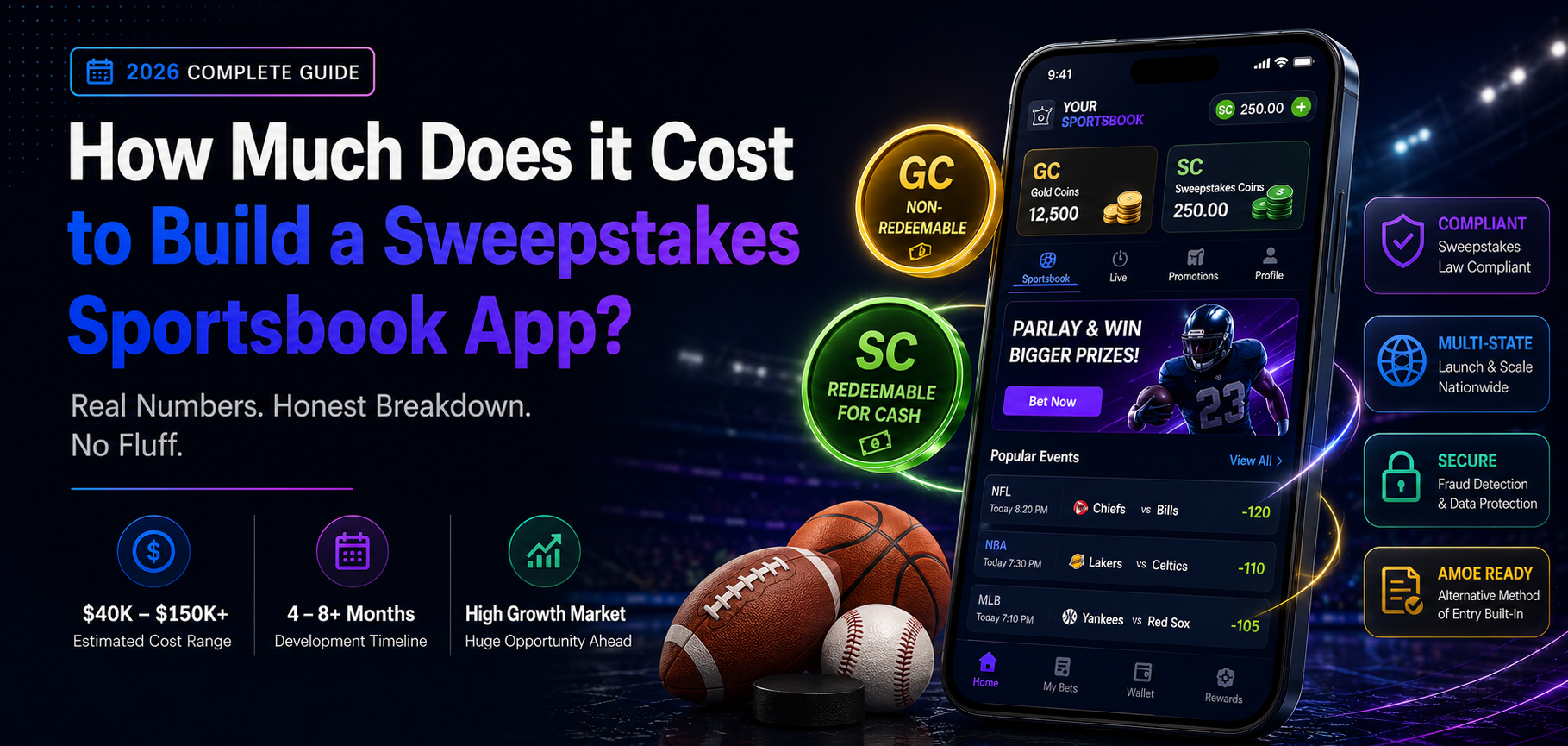
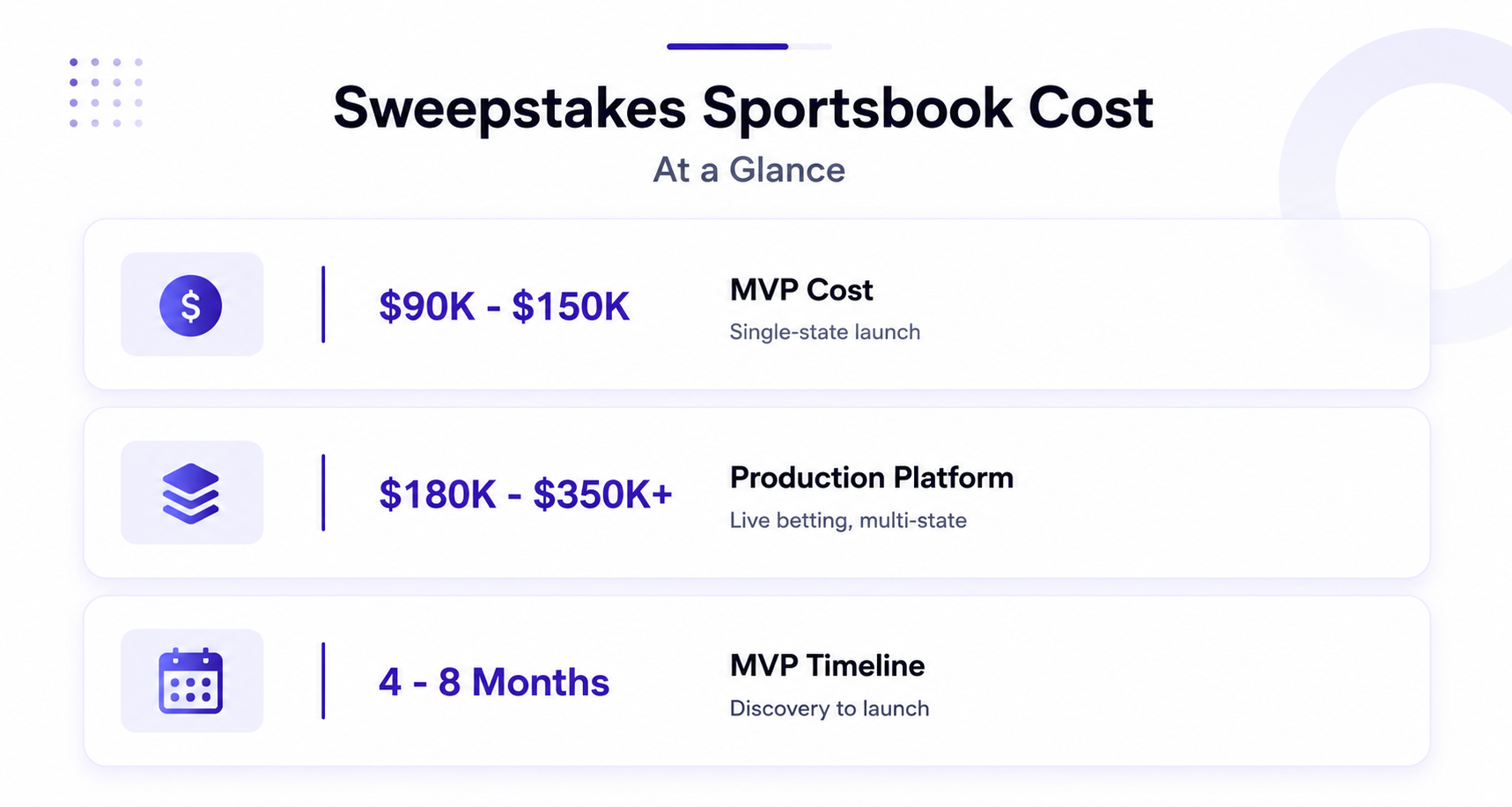
Quick Answer: A functional sweepstakes sportsbook MVP (single-state launch, core betting markets, dual-wallet, basic KYC/geo) typically costs $90,000-$150,000 and takes 4-8 months. A production platform built for multi-state scale, live betting, fraud scoring, and a defensible AMOE flow runs $180,000-$350,000+. We break down exactly where that money goes below.
The money moving into this category isn’t speculative anymore. The American Gaming Association’s State of Play research has tracked legal U.S. sports betting handle climbing past $150 billion annually, and the growth curve on the social/sweepstakes side is arguably steeper because it isn’t gated by state licensing timelines the way traditional online sportsbooks are.
Prediction markets are pulling the same investor attention for a related reason — platforms like Kalshi and Polymarket proved that regulatory-creative market structures around betting-adjacent products can scale fast when the legal wrapper is sound. Fantasy sports, the category we’ve built the most in (see our breakdown of what a fantasy sports app costs to build), has matured into a $10B+ U.S. industry per Fantasy Sports & Gaming Association data, and sweepstakes sportsbooks are picking up a meaningful share of that same audience — bettors who want the parlay-and-live-odds experience without needing a licensed sportsbook available in their state.
Why is capital flowing in now specifically? Three reasons, in our experience talking to operators and investors in this space:
A sweepstakes sportsbook is a betting-style platform that operates on a legal theory borrowed from sweepstakes casinos, not sports betting law. Users don’t wager money directly on outcomes. Instead, the platform sells (or gives away) two currencies:
That last part — AMOE, Alternative Method of Entry — is the legal foundation the entire model rests on. U.S. sweepstakes law requires that anyone must be able to receive entries without paying, typically via mail-in request or an in-app free-claim mechanism (daily login bonus, social task, etc.). If your AMOE flow is an afterthought — buried in a submenu, functionally unusable, or slower than the paid path — you don’t have a sweepstakes product anymore. You have an unlicensed gambling product wearing a sweepstakes costume, and that’s the exact distinction state regulators are now actively testing.
How this differs from adjacent categories, because founders conflate these constantly:
| Category | Money Flow | Legal Basis | Licensing Burden |
| Traditional Sportsbook | Real money, direct wager | State gambling license | Very high, state-by-state |
| Sweepstakes Sportsbook | Dual currency, promotional | Sweepstakes/promotions law | Low-moderate, still state-aware |
| Daily Fantasy Sports | Real money, skill-based entry fees | Fantasy sports carve-out laws | Moderate, state-specific |
| Prediction Market | Real money, contract-style | CFTC/exchange framework | High, federal-level |
| Social Casino | Virtual currency, no cash-out | General app terms | Minimal |
We quote founders anywhere between $90K and $350K+ for what sounds, on a discovery call, like “the same app.” Here’s what actually moves that number, in the order it usually surprises people:
Founder Note: the single biggest cost lever isn’t any one feature — it’s how many of these you try to build simultaneously in v1. We’ll get into sequencing below, because it’s where we save clients the most money without cutting anything that matters.
This is the module-level view we actually use in our own scoping documents. Complexity ratings assume a mid-sized team of senior engineers, not a solo freelancer or an offshore volume shop.
| Feature | Est. Hours | Est. Cost | Complexity |
| Authentication & account mgmt | 80-120 | $4,800-$9,600 | Low |
| Dual-currency wallet engine | 320-480 | $19,200-$38,400 | Very High |
| Real-time odds integration | 200-320 | $12,000-$25,600 | High |
| Leaderboards & gamification | 100-160 | $6,000-$12,800 | Medium |
| Referral engine | 60-100 | $3,600-$8,000 | Low-Medium |
| Push notification system | 60-90 | $3,600-$7,200 | Low-Medium |
| In-app chat / social feed | 140-220 | $8,400-$17,600 | High |
| Admin & ops console | 180-280 | $10,800-$22,400 | High |
| Fraud detection & scoring | 160-260 | $9,600-$20,800 | Very High |
| KYC integration | 80-120 | $4,800-$9,600 | Medium |
| Payment gateway integration | 120-180 | $7,200-$14,400 | High |
| Compliance / geo-fencing layer | 140-220 | $8,400-$17,600 | Very High |
| Analytics & reporting | 80-140 | $4,800-$11,200 | Medium |
| Rewards & loyalty system | 90-150 | $5,400-$12,000 | Medium |
Cost-Saving Tip: chat/social feed and full gamification are the two rows on this table founders most often keep in v1 out of FOMO and cut in v2 out of necessity. If budget is tight, that’s the first place to trim — the wallet, odds, KYC, and compliance rows are not optional at any budget.
| Stage | % of Budget | What Happens |
| Discovery & compliance scoping | 5-8% | Legal review of AMOE structure, state-exclusion list, wallet requirements definition |
| UI/UX design | 10-12% | Wireframes, betting-slip flows, wallet UX, admin console design |
| Architecture & data modeling | 8-10% | Dual-ledger schema, event-sourcing design, odds-feed abstraction layer |
| Backend development | 30-35% | Wallet, odds engine, KYC/geo, fraud scoring, admin API |
| Frontend development | 20-25% | iOS, Android, responsive web clients |
| QA & compliance testing | 8-10% | Ledger reconciliation testing, geo-fence penetration testing, load testing |
| DevOps & launch | 5-7% | CI/CD, infra provisioning, store submission, monitoring setup |
| Post-launch stabilization | 5-8% | Bug fixes, first-month monitoring, hotfixes ahead of a marketing push |
We steer almost every first-time operator toward an MVP that’s narrower than they initially want — not because the full vision is wrong, but because betting products need real usage data to tune odds margins, promo economics, and fraud thresholds before you scale spend behind them.
| Dimension | MVP | Production Platform |
| States supported | 1-3 launch states | 15-25+ states |
| Betting markets | 3-5 core sports, pre-game only | 10+ sports, live/in-play betting |
| Wallet | Dual currency, manual redemption review | Automated redemption, tiered fraud scoring |
| KYC | Single-vendor, redemption-gated only | Tiered verification, ongoing monitoring |
| Social features | Referral only | Feed, chat, communities, leaderboards |
| Personalization / AI | None | Predictive picks, personalized promos |
| Est. cost | $90,000-$150,000 | $180,000-$350,000+ |
| Timeline | 4-8 months | 8-14 months |
What investors actually expect at MVP stage, based on the fundraising conversations our clients have walked us through afterward: a working dual-wallet with a real (not simulated) redemption event completed, one clean state-compliant launch market, and retention numbers — not feature count. Nobody has ever gotten a term sheet for having live betting markets in 12 sports at pre-seed.
This is the section that determines whether your budget survives contact with reality. Every one of these gets left out of a first-pass estimate, and every one of them shows up on an invoice within 90 days of launch.
Expert Tip: ask any vendor quoting you a fixed price to build this app whether that price includes odds-feed integration testing against a live provider account, not a mock. If it doesn’t, the “fixed price” isn’t fixed — it’s the price before the first real bill arrives.
Not all features cost the same multiplier. Here’s how we rank the ones founders ask for most, roughly ordered by cost impact:
| Layer | Recommended Options | Why |
| Mobile | React Native or native Swift/Kotlin | React Native for speed to v1; native when live-odds UI performance becomes the bottleneck |
| Backend | Node.js (NestJS) or Go | Go for the odds/risk engine’s concurrency needs, Node for everything else |
| Database | PostgreSQL + event-sourced ledger tables | Wallet integrity needs an auditable, append-only transaction history |
| Real-time layer | Redis + WebSockets / Kafka | Sub-second odds propagation to thousands of concurrent connections |
| Payments | Stripe + in-app billing (Apple/Google) | Coin purchases must respect platform billing rules; payouts need a separate rail |
| Cloud | AWS or GCP with auto-scaling groups | Game-day traffic spikes demand elastic infrastructure, not fixed capacity |
| Notifications | Firebase Cloud Messaging + Twilio | Push for odds/redemption alerts, SMS for verification |
| Monitoring | Datadog or Grafana + Prometheus | Game-day incidents need real-time visibility, not next-morning log review |
| CI/CD | GitHub Actions + Docker/Kubernetes | Frequent deploys without downtime during live betting windows |
| Security | Vault for secrets, WAF, SOC 2-aligned practices | Wallet and KYC data demand infrastructure-level security, not just app-level |
| Analytics | Amplitude or Mixpanel + a warehouse (Snowflake/BigQuery) | Cohort and LTV modeling needs raw event data, not just a dashboard tool |
Architecture Insight: build the wallet as an event-sourced ledger from day one, even in the MVP. Retrofitting an auditable transaction history onto a mutable-balance wallet after launch is one of the most expensive rewrites we’ve seen founders have to commission — usually right after their first redemption dispute.
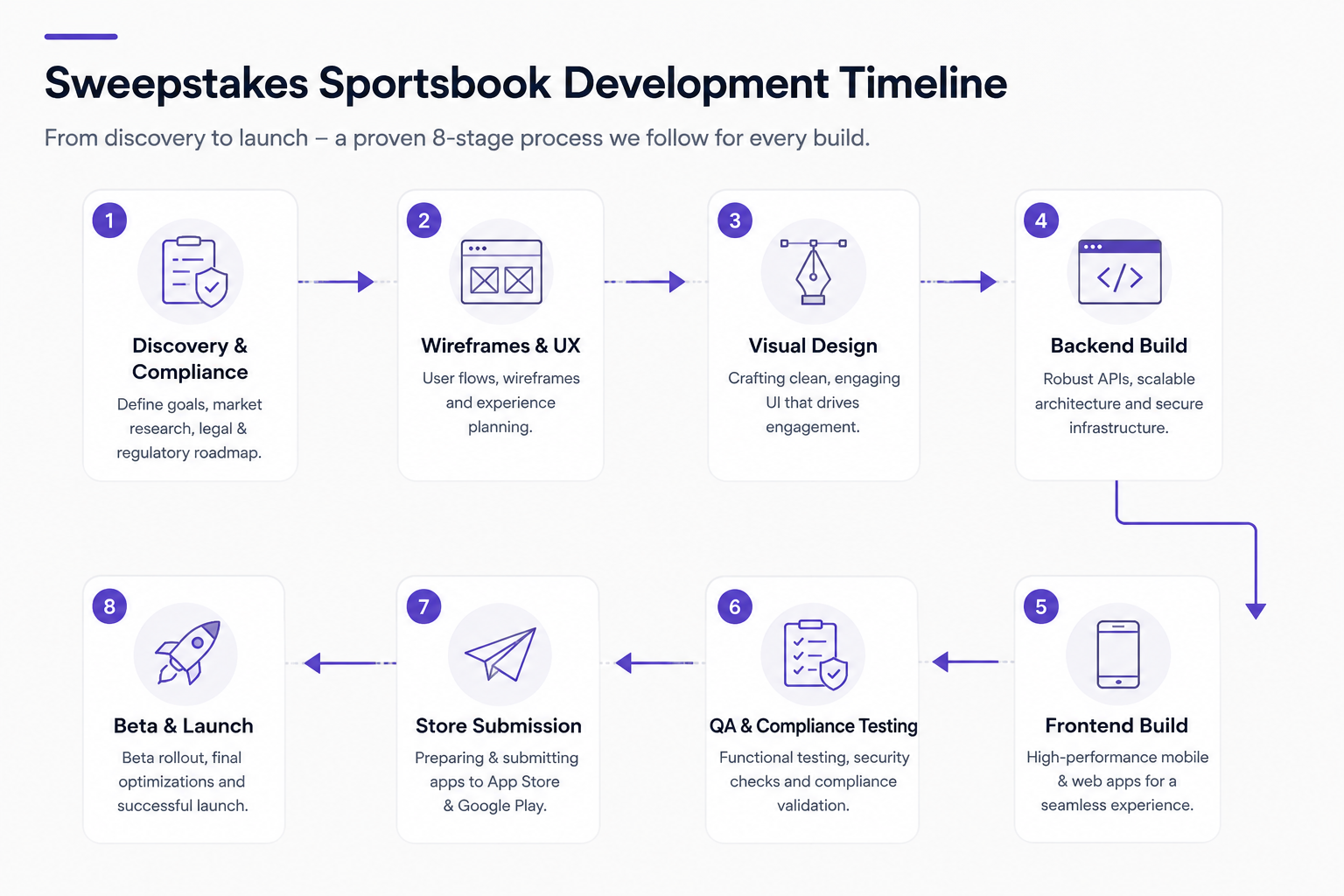
| Phase | Duration | Weeks | Key Output |
| Discovery & compliance scoping | 2-3 weeks | 1-3 | State-exclusion list, AMOE structure signed off by counsel |
| Wireframes & UX flows | 2 weeks | 4-5 | Betting-slip, wallet, and redemption flows mapped |
| Visual design | 2-3 weeks | 6-8 | Full UI kit across mobile and admin |
| Backend build | 8-12 weeks | 9-20 | Wallet, odds engine, KYC/geo, fraud scoring |
| Frontend build | 6-10 weeks | 14-24 (parallel) | iOS, Android, web clients |
| QA & compliance testing | 3-4 weeks | 25-28 | Ledger reconciliation, geo-fence, load testing passed |
| Store submission | 1-3 weeks | 29-31 | App Store/Play Store approval (buffer for rejection cycles) |
| Beta & launch | 2-3 weeks | 32-34 | Limited-state soft launch, monitoring in place |
We’ve been brought in to fix more sweepstakes-sportsbook builds than we’d like, usually after a founder’s first vendor ran out of runway or credibility. The pattern repeats:
Founder Note: the fastest way to double your budget on this category isn’t a bad vendor. It’s a good vendor building the wrong scope, because nobody forced the sequencing conversation before the SOW was signed.
| Approach | Cost | Control | Best For |
| Custom build | $90K-$350K+ | Full | Operators building a defensible, differentiated product with real IP |
| White-label platform | $15K-$40K + rev share | Low | Fast market testing, minimal differentiation needed |
| Licensed software + customization | $40K-$120K | Moderate | Operators who want speed with some brand/feature control |
White-label is a legitimate choice for testing market appetite fast, but it comes with a ceiling: you’re sharing revenue indefinitely, you can’t differentiate on wallet mechanics or promo design, and — this is the part vendors don’t lead with — you generally don’t own the compliance architecture, which means you’re trusting someone else’s AMOE implementation with your operating license risk. If you’re raising a real seed round on this category, investors will ask which one you did, and “custom” answers a question white-label can’t.
We didn’t come to this category from a generic app-dev background looking for a new vertical to sell into. We’ve built the fantasy-sports and sweepstakes-adjacent stack enough times to have opinions about it, and those opinions show up in how we scope every engagement.
Our engineering philosophy on this category starts with the wallet, not the UI. Every build we scope begins with the ledger schema and the compliance boundary it has to enforce — because that’s the part that’s expensive to fix later and cheap to get right up front. We design event-sourced, auditable transaction systems by default, not as an upsell.
Our architecture approach treats odds integration as an abstraction layer from day one, so switching or adding a data provider is a configuration change, not a rewrite. We size infrastructure for game-day peak load, not average load, because we’ve watched what happens to platforms that don’t.
Our product discovery process puts compliance scoping before wireframes — we want the state-exclusion list and AMOE structure settled before a single screen gets designed, because UX decisions downstream (like how prominent the free-entry path is) are compliance decisions, not just design ones.
Our scalability mindset assumes you’ll want multi-state expansion and live betting eventually, even if v1 doesn’t include them — so nothing in the MVP architecture blocks that path, even though we’re deliberately not building it all at once.
On the AI side, we build predictive-picks and personalization features on real usage data pipelines, not as a thin LLM wrapper — which matters if you ever want those features to be a genuine differentiator instead of a demo-day feature.
Our DevOps practices assume Sunday-afternoon traffic spikes are a normal Tuesday, not an incident. And our post-launch support model is built around the reality that this category needs ongoing compliance monitoring, fraud-pattern updates, and odds-provider relationship management — not a handoff after launch and a support ticket queue.
We also build fantasy sports platforms and understand where that audience and this one overlap, and our teams work the same way we do on every dedicated-team engagement — embedded, accountable, and scoped around your actual risk, not a generic SOW template.
The founders who do well in this category treat the wallet and compliance layer as the product, and the betting UI as the part everyone else can copy anyway. Get the ledger, the AMOE flow, and the geo-fencing right, and the rest — odds feeds, leaderboards, referral loops — is straightforward, well-understood engineering. Get it wrong, and no amount of UI polish saves you from a redemption dispute you can’t explain or a state regulator you can’t answer.
If you’re scoping a build and want a real number instead of a range, tell us your target launch states and which features you actually need in v1 versus which ones you want a clean path to add later. That conversation usually takes 30 minutes and saves founders more than it costs them.
A functional MVP typically costs $90,000-$150,000 and takes 4-8 months. A production platform with live betting, multi-state compliance, and automated redemption runs $180,000-$350,000+ and takes 8-14 months.
Sweepstakes sportsbooks operate under promotional-sweepstakes law rather than gambling law, which generally doesn’t require a state gambling license — but this depends on a properly implemented Alternative Method of Entry (AMOE) and correct dual-currency separation. This is a legal question that needs real counsel, not a generic answer; several states have already increased scrutiny of the model.
Gold Coins are a promotional currency used for entertainment play with no cash value. Sweepstakes Coins (often called Sweeps Cash) are a promotional currency that can be redeemed for real cash prizes, typically obtained as a bonus with Gold Coin purchases or free through AMOE.
Most MVPs launch with pre-game odds that update on a scheduled basis rather than true real-time in-play odds, since live betting is one of the most expensive features to build. Static or scheduled-refresh odds let you validate demand before committing budget to a real-time risk engine.
Integrating a managed KYC vendor (like Persona or Onfido) typically takes 3-5 weeks of engineering time. The bigger time investment is compliance scoping with legal counsel before development starts, which we recommend budgeting 2-3 weeks for regardless of technical complexity.
White-label is reasonable for fast market testing with minimal differentiation, but you’ll share revenue indefinitely and typically don’t control the compliance architecture underlying your own license risk. Custom build costs more upfront but gives you full control over the wallet, compliance layer, and product roadmap.
Plan for odds/data licensing ($2,000-$8,000+/month), cloud infrastructure sized for game-day peaks, KYC and fraud-scoring vendor fees (usage-based), CRM/lifecycle tooling, and ongoing legal review as state sweepstakes law evolves. These typically add $6,000-$18,000+/month depending on scale.
Several states have increased scrutiny of the sweepstakes-casino and sweepstakes-sportsbook model, including Washington, Idaho, and Montana, with the regulatory landscape actively shifting. Your launch-state list should be reviewed by counsel close to your actual launch date, not locked in at the start of development.
Daily fantasy sports involves real-money entry fees into skill-based contests under fantasy-sports carve-out laws. A sweepstakes sportsbook uses a dual promotional-currency model under sweepstakes law, with no direct real-money wager on outcomes — the legal foundations and licensing requirements are meaningfully different.
Yes, and we generally recommend it. If your odds-abstraction layer is designed correctly from the start, adding live betting later is an extension of existing architecture rather than a rebuild — but retrofitting it onto a poorly designed odds layer is expensive.
A typical MVP team is 4-6 people: a backend lead, one or two backend engineers, one or two mobile engineers, and a QA engineer, with part-time design and DevOps support. Production-scale builds usually add a dedicated data/fraud engineer and a second mobile platform specialist.


Jeeto11
The app quickly earned over 1,000 downloads within two months of launch, and users have responded positively. ARKA Softwares boasted experienced resources who were happy to share their knowledge with the internal team.

Archithrones
While the development is ongoing, the client is pleased with the work thus far, which has met expectations. ARKA Softwares puts the needs of the client first, remaining open to feedback on their work. Their team is adaptable, responsive, and hard-working.

Service Provider
I started my project with Arka Softwares because it is a reputed company. And when I started working with them for my project, I found out that they have everything essential for my work. The app is still under development and but quite confident and it will turn out to be the best.