Think about the last time a playlist stopped you mid-scroll. Not because you searched for it. Not because a friend shared it. But because an app somehow knew exactly what you needed to hear.
That’s not a coincidence. That’s a machine learning model watching your skip patterns, your replay counts, and the exact moment you turned the volume up.
There are over 100 million tracks on Spotify. Apple Music hosts roughly the same. Amazon Music, YouTube Music, and Tidal have libraries that are virtually infinite. That catalog depth was supposed to be the product. More music equals more value.
What platforms discovered quickly is that infinite choice without intelligent curation produces the opposite of engagement. Users faced with 100 million tracks and a blank search bar don’t explore.
They default to the five artists they already know, listen to the same three albums, and eventually wonder why they’re paying a subscription for something they could get from a YouTube playlist.
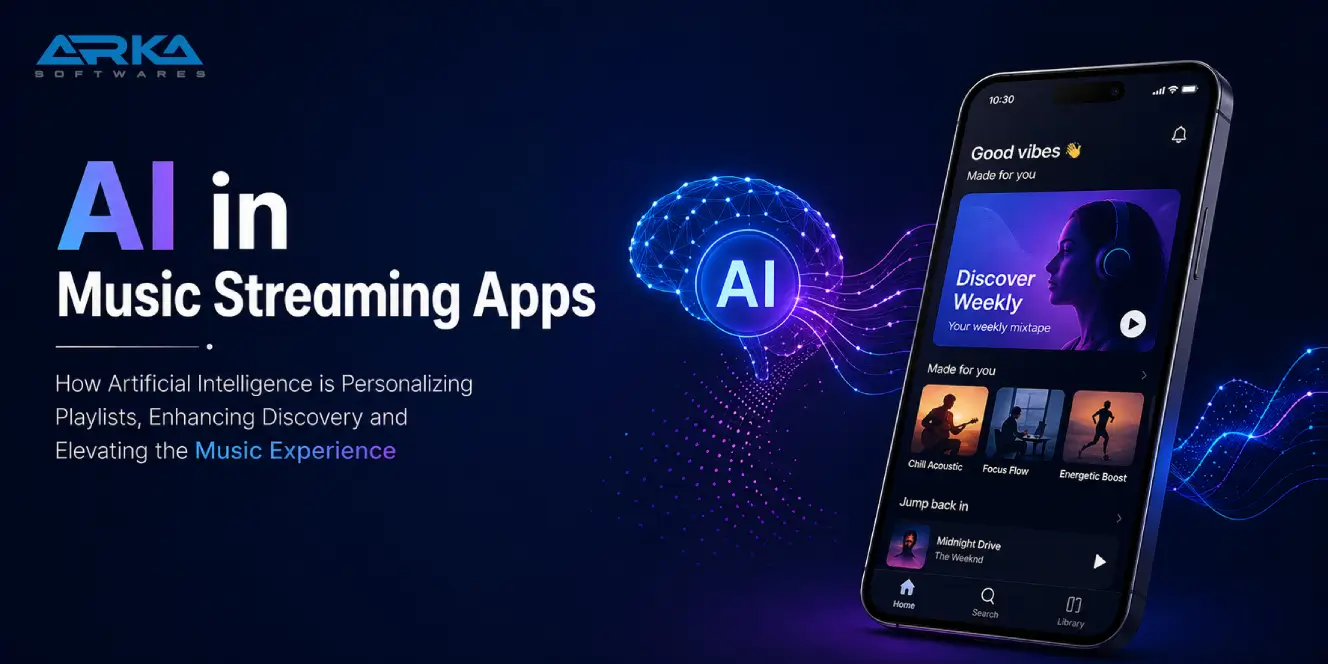
This is the fundamental challenge every music streaming product faces, and it’s why AI in music streaming app development has moved from a nice-to-have feature to the core of every competitive product on the market.
The apps winning retention aren’t winning on catalog size. They’re winning because they know what you want to hear before you do.
If you’re a founder, CTO, or product leader evaluating this space, this guide focuses specifically on the AI and personalization layer, how it works, what it delivers, how leading platforms have built it, and what separates implementations that drive retention from ones that just look impressive in a pitch deck.
The global music streaming market was valued at approximately $26 billion in 2023 and is projected to exceed $47 billion by 2030, growing at a CAGR of around 8.5%. Mobile accounts for over 60% of all streams. The opportunity is real.
But market growth doesn’t mean easy entry. Spotify has 602 million monthly active users. Apple Music holds an estimated 88 million subscribers. The market isn’t winner-take-all, but it is quality-take-most.
The platforms growing fastest share one characteristic: their AI recommendation systems are accurate enough that users feel genuinely understood. That emotional connection “this app gets my taste” drives subscription upgrades, reduces churn, and generates word-of-mouth. It cannot be faked with a decent UI and a large library.
Spotify invests hundreds of millions annually in machine learning infrastructure. Their Discover Weekly feature alone generates over 2.5 billion streams per month. That’s the competitive bar. Understanding how they built it is the starting point for anyone planning to enter this space.
Most people assume music recommendation is a “people who liked X also liked Y” equation. The reality is considerably more sophisticated, and understanding it matters whether you’re a user wondering why the app feels so accurate or a founder deciding where to allocate development budget.
The foundation of most AI music recommendation systems. The model identifies users with overlapping taste profiles and surfaces tracks that similar users have responded well to. At Spotify’s scale, these clusters become extraordinarily fine-grained.
It’s not “jazz fans.” It’s “jazz fans who listen during morning commutes, skip anything with prominent brass, and replay tracks with a specific tempo range.”
The weakness: collaborative filtering is blind to new tracks with no listening history and struggles with niche tastes that don’t cluster well across a broad population. This is where the next layer matters.
Platforms like Spotify run every track through audio analysis models that extract dozens of measurable features: tempo, key, loudness, energy, danceability, acousticness, instrumentalness, and valence (musical positivity). Each track becomes a vector in a high-dimensional sonic space.
The system can then recommend music based on how a track sounds, independent of whether anyone else has listened to it. A newly uploaded independent artist track with zero plays can still surface in relevant recommendations because its audio fingerprint matches the sonic profile a user has demonstrated a preference for.
Spotify, YouTube Music, and Apple Music all run NLP models across massive volumes of text music blogs, playlist titles, editorial descriptions, and social posts to extract contextual and cultural signals about tracks and artists.
When thousands of playlists are titled “Sunday morning coffee,” and they share a core set of tracks, that semantic association becomes part of the recommendation model. The track isn’t just tagged by tempo or key. It carries contextual meaning that no manual metadata process could capture at scale.
The most underappreciated layer. Every skip, every replay, every volume adjustment, every pause, every playlist add these signals update the user’s taste model in real time.
The best AI-powered music apps don’t just learn your preferences over time. They learn them during the session, adjusting what comes next based on what you just did.
If you skip the first three seconds of four songs in a row, that’s data. The model recalibrates immediately. The combination of all four layers, collaborative filtering, audio analysis, NLP, and real-time behavioral signals, is what makes modern AI music recommendations feel uncanny in their accuracy.
The historical model for music discovery was radio, editorial playlists, and word of mouth. All three required effort or luck. AI personalization makes discovery ambient; it happens as a byproduct of listening, not as a deliberate act.
Spotify’s Discover Weekly generates a fresh 30-track playlist for each of its 600 million users every Monday. Users who engage with it consistently report surfacing artists they’d never heard of but immediately loved. That feeling of discovering something that feels made for you is one of the most powerful emotional experiences a music product can deliver. And it’s entirely AI-generated.
When recommendations are accurate enough, users stop thinking of the app as a catalog they search through and start thinking of it as something closer to a musical companion. That relationship shift has a direct impact on churn.
Users who feel understood by an app are dramatically less likely to leave, not because switching is technically difficult, but because starting over means losing a taste profile that took months to build. The AI creates a switching cost that no pricing strategy can replicate.
Modern AI music apps don’t just learn what you like. They learn when you like it and what you’re probably doing. Morning listening behavior differs from late-night listening. Gym sessions have different audio signatures than deep work.
Spotify’s Daylist feature generates dynamically updated playlists that refresh multiple times per day, labeled with contextual descriptors based on behavioral patterns. It’s not “your daily mix.”
It’s “your restless indie Friday afternoon,” a playlist that couldn’t exist without AI interpreting the intersection of time, context, and individual behavioral history.
Rather than asking users to self-report their emotional state, AI systems infer mood from behavioral signals. Skipping uptempo tracks repeatedly? The model registers you’re not in that headspace and adjusts. Replaying the same melancholic track three times? The queue shifts accordingly.
Research suggests contextually matched mood recommendations extend average session length by 35–40%. The user doesn’t notice the mechanism. They just notice they don’t want to stop listening.
1. Search that understands intent, not keywords: Legacy music search returns results for exact artist or track names. AI-powered search interprets natural language intent, “something calm for late-night reading,” returns a curated result, not an error. Approximately 27% of mobile users regularly use voice commands for music requests, making voice search an expected functionality for mobile-first products.
2. Dynamic home screen surfaces: A well-built music app home screen is not a static layout. AI models determine which modules surface for which users, new releases weighted toward artists in that user’s taste graph, not the editorial team’s preferences.
3. Social and collaborative features: Shared playlist generation and group listening sessions become genuinely useful when AI models understand the intersection of multiple taste profiles. “A playlist both you and your partner will like” is a real feature that requires understanding two independent behavioral datasets.
4. Predictive churn prevention: Predictive models identify behavioral signals that precede subscription termination, declining session frequency, shorter listen time, and increasing skip rates, and trigger re-engagement before the user churns. Spotify’s Wrapped campaign is a retention mechanism built on predictive data, timed to Q4 when cancellations historically spike.
Spotify runs multiple independent ML models simultaneously, including audio features, listening context, social signals, and editorial data, and blends their outputs using a ranking model that weights each signal based on its predictive accuracy for that specific user. No single model drives the result. The competitive advantage is in how the layers combine.
YouTube Music benefits from one of the largest behavioral datasets in the world, Google’s entire search and video consumption history. Their models use transfer learning to apply patterns from video behavior to music discovery.
A user who watches a lot of lo-fi study content on YouTube will find their YouTube Music recommendations shaped by that signal before they’ve listened to a single track on the platform.
Amazon Music’s differentiation is voice-first interaction through Alexa. Their NLP models handle highly conversational requests and return contextually appropriate results.
The integration between their catalog, user profile data, and Alexa’s language understanding creates a discovery experience that feels genuinely assistive rather than mechanical.
Personalization isn’t a product nicety. It’s the primary driver of the metrics that matter.
Platforms with strong AI recommendation systems consistently outperform editorial-only or search-first competitors on every retention metric.
Churn rates run 20–30% lower. Average session lengths are measurably longer. Subscription upgrade rates are higher among users who engage with personalized recommendations than among those who primarily use search.
The mechanism is straightforward: a user who feels an app understands their taste has a reason to come back tomorrow. Multiply that across millions of users, and the compounding effect on lifetime value becomes the most important financial variable in the business.
This is why Spotify, Apple Music, and Amazon Music have all invested hundreds of millions in ML infrastructure despite being fundamentally content licensing businesses. The content is the commodity. The personalization layer is the product.
Evaluating whether to build or expand your music streaming product? Talk to our mobile app development team to map out the right AI architecture for your product stage before locking in infrastructure decisions that are expensive to undo.
1. Smart Recommendation Engine: Combines collaborative filtering, content-based audio analysis, and contextual signals. The central nervous system of the product. Not optional.
2. Natural Language Search: Interprets conversational intent beyond keyword matching. “Songs for a rainy day drive” should return curated results, not a blank page.
3. Real-Time In-Session Adaptation: If a user skips three uptempo tracks in a row, the system recalibrates immediately, not at the next session. Requires real-time event processing infrastructure, not batch updates.
4. User Behavior Tracking and Modeling: Every skip, replay, and playlist add feeds the recommendation loop. The product improves because it learns, but only if data architecture supports this from day one.
5. Automated Content Tagging: AI models that analyze and tag new tracks as they enter the catalog, without manual metadata input. Essential for keeping recommendations accurate as the library grows.
AI/ML: Python, TensorFlow or PyTorch for model training, Scikit-learn for collaborative filtering, Librosa for audio feature extraction, Hugging Face models for NLP-powered search
Real-Time Data Infrastructure: Apache Kafka for event streaming, Redis for session caching and in-session recommendations, and Elasticsearch for search indexing
Cloud ML Platforms: Google Cloud Vertex AI or AWS SageMaker for model deployment and retraining pipelines.
Music Intelligence APIs (early-stage): AudD for audio recognition, Musixmatch for lyrics and metadata, Last.FM API for listening history and social listening data
For the full frontend, backend, and cloud infrastructure breakdown, see our complete music streaming app development guide.
Every new user is a cold start. Every new track is a cold start. Solving it requires onboarding flows that capture explicit taste preferences, content-based analysis that doesn’t depend on listening history, and editorial curation for new accounts.
The strongest platforms treat cold start as a first-class product problem addressed from day one, not deferred to a future sprint.
A recommendation engine optimized purely for engagement will eventually trap users in a taste bubble, surfacing only what they’ve already liked, suppressing discovery of genuinely new music.
Building intentional diversity parameters into recommendation logic is both an ethical consideration and a product quality decision. The short-term engagement metric dips slightly. The 90-day retention number improves.
GDPR in Europe, CCPA in California, and emerging frameworks in the UAE and UK all impose strict requirements on how behavioral data is collected, stored, and used. Building compliance into the data architecture at the start costs a fraction of retrofitting it after a regulatory inquiry.
Third-party APIs provide a fast, affordable foundation for MVP personalization. But as scale increases, the limitations of off-the-shelf models become visible.
Designing the data architecture to support proprietary ML evolution from the beginning is what separates products that can grow from ones that hit a ceiling.
Data strategy is the product strategy. Your recommendation system is only as good as the behavioral data feeding it. How you instrument user sessions, what signals you capture, and how you store and process them is not an infrastructure decision. It’s a product decision.
Cold start is not an edge case. Every new user is a cold start. Building robust onboarding flows and content-based analysis models that don’t depend on listening history isn’t optional; it determines how good recommendations are in week one.
The compliance layer is not separable from the AI layer. GDPR, CCPA, and emerging privacy regulations need to be in the initial architecture, not a future sprint.
Build vs. buy at the right moments. Start with music intelligence APIs. Build proprietary models when your data volume and competitive positioning justify it.
For a detailed breakdown of development timelines, team structures, and what each build phase actually costs, see our music streaming app development cost guide.
There are hundreds of music apps. There are very few that users describe as indispensable.
The difference isn’t catalog size, audio quality, or interface design, though all matter at the margins. The difference is whether the app understands a user well enough to surface what they want to hear without requiring them to look for it.
That capability is built through deliberate AI architecture, high-quality behavioral data infrastructure, and recommendation logic that balances accuracy with discovery. It compounds over time as the model learns. It creates switching costs that pricing never could.
The content is the commodity. The personalization layer is the product. And building it correctly at the right stage, with the right stack, without over-engineering for scale you don’t yet have is the decision that separates the apps people love from the ones they forget.
It’s also the decision every music streaming app development company gets asked to make on behalf of their clients, and where the right technical judgment makes all the difference.
Ready to build AI-powered personalization into your music streaming product? Talk to our team, we’ll map out the right architecture for your product stage, not the most technically impressive one.
AI personalization combines collaborative filtering, content-based audio analysis, and natural language processing alongside real-time behavioral signals, skips, replays, and session patterns to surface music that matches what a user wants right now, not just what they’ve historically preferred.
The cold start problem refers to the challenge of generating accurate recommendations for new users with no listening history and new tracks with no listening data. Strong platforms solve it through onboarding flows that capture explicit taste preferences, content-based audio analysis, and editorial curation for new accounts.
Yes. Most startups should begin with third-party music intelligence APIs and pre-trained recommendation models rather than proprietary ML infrastructure. As behavioral data accumulates, proprietary model training becomes feasible. The critical requirement is designing the data architecture from the start to support this evolution.


Jeeto11
The app quickly earned over 1,000 downloads within two months of launch, and users have responded positively. ARKA Softwares boasted experienced resources who were happy to share their knowledge with the internal team.

Archithrones
While the development is ongoing, the client is pleased with the work thus far, which has met expectations. ARKA Softwares puts the needs of the client first, remaining open to feedback on their work. Their team is adaptable, responsive, and hard-working.

Service Provider
I started my project with Arka Softwares because it is a reputed company. And when I started working with them for my project, I found out that they have everything essential for my work. The app is still under development and but quite confident and it will turn out to be the best.