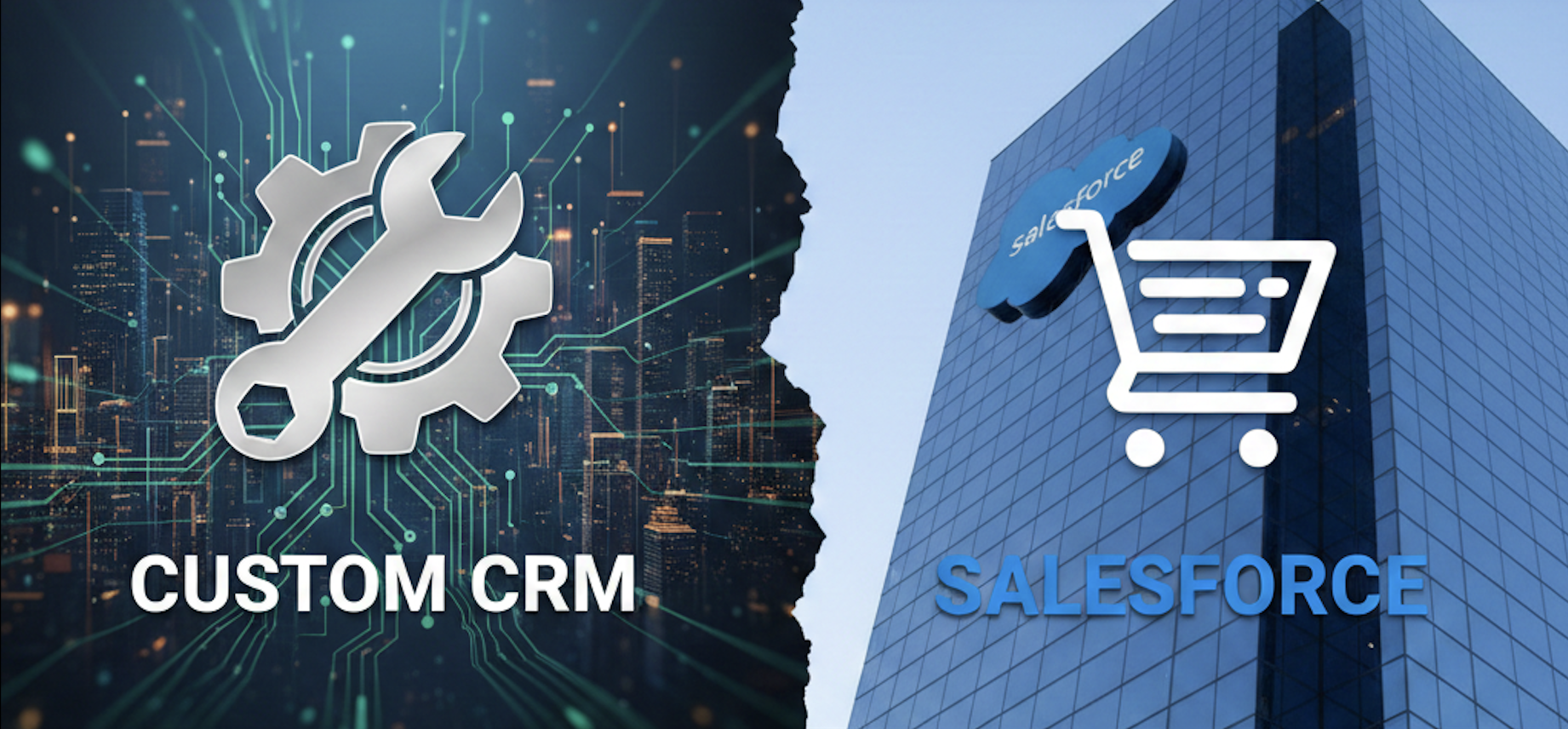
Every growing enterprise eventually hits a crossroad: Do you adapt your business processes to fit a platform like Salesforce, or do you build a CRM that adapts to you?
While Salesforce is the undisputed titan of the CRM world, it isn’t a one-size-fits-all miracle. Choosing the wrong path can lead to “feature bloat” (paying for tools you never use) or “operational friction” (using a system that doesn’t support your unique workflow). At Arka Softwares, we help businesses weigh the long-term ROI of both paths to ensure your technology accelerates your growth rather than hindering it.
Salesforce is powerful, but for many businesses, it’s like buying a commercial jet to drive across the street. Most decision-makers face these three mental roadblocks:
Research shows that 80% of users only use 20% of the features in big SaaS platforms. If you have 50 employees on an Enterprise plan, you could be wasting over $150,000 a year on tools your team ignores.
When a CRM is too complex, employees revert to private notes and messy emails. This friction costs companies an average of 20% in lost productivity every single week.
Most enterprise CRM costs don’t stop at the license. Between setup and “expert” consultants, a mid-sized rollout often hits $75,000 to $100,000 before the first login.
Different industries face different “friction” points. Here is how the build vs. buy decision impacts your specific sector:
In healthcare, data privacy isn’t just a feature—it’s a legal requirement.
Tip: If you need a patient-first experience, Custom Healthcare Software often beats a generic CRM.
Security and real-time data processing are the lifeblood of Finance.
Tip: Own your algorithm and your data with our FinTech Development Solutions.
Logistics requires deep integration with hardware, GPS, and warehouse databases.
High-volume lead management and automated property matching are key.
If your goal is rapid scaling and you require a massive ecosystem of third-party integrations, our Salesforce Development Services are designed to maximise this platform’s potential.
A custom-built solution is a strategic asset. If you have proprietary workflows or unique data structures, our Custom CRM Development team builds tools that you own completely.
| Feature | Salesforce (The “Rent” Model) | Custom CRM (The “Own” Model) |
|---|---|---|
| Upfront Cost | Low to Moderate | High Initial Investment |
| Ongoing Cost | High (Per-user licenses) | Low (Maintenance & Hosting) |
| Time to Market | Fast | Moderate to Long |
| Scalability | High (Immediate) | High (Controlled) |
| Flexibility | High (Within ecosystem) | Unlimited |
Seeing how other enterprises navigated this choice helps de-risk the decision for your business.
Before booking a consultation, use this simple formula to estimate your Total Cost of Ownership (TCO) over 5 years:
TCO = (Upfront Build/Setup + (Annual License × Users × Years)) – Productivity Gains
For a mid-sized enterprise with 50 users over a 5-year horizon:
| Metric | Salesforce Enterprise | Custom CRM (Bespoke) |
|---|---|---|
| Upfront Cost | ~$75,000 (Setup/Migration) | ~$250,000 (Build) |
| Annual Licensing | $150,000 / year | $0 |
| 5-Year Total | $825,000+ | $350,000 (inc. maintenance) |
| Breakeven Point | Never (Recurring) | Year 2 |
Note: Custom CRM users typically see a 20-30% boost in productivity because the tool is built around their existing habits, not the other way around.
According to industry data from Gartner and Forrester, the “one-size-fits-all” approach has hidden pitfalls:
We don’t believe in pushing one solution over another. Whether you need a sophisticated Mobile App Development integration for your CRM or a long-term AI Strategy to automate your data, we protect your margins.
Our process starts with:
Requirement Audit: Analysing your current pain points and 5-year growth projections.
Gap Analysis: Determining if Salesforce’s “out-of-the-box” features cover your needs or if the “customisation tax” is too high.
Cost-Benefit Projection: Providing a clear TCO (Total Cost of Ownership) comparison for both paths.
Ready to build a smarter way to manage your customer relationships?
Don’t guess when it comes to your data infrastructure. Let’s discuss which path offers the best ROI for your unique business goals.
A Minimum Viable Product (MVP) typically takes 3-6 months. This allows you to start migrating data and seeing ROI while we continue to add advanced features in modular sprints./span>
A: Unlike “closed” platforms, our custom builds use modular architecture. This means we can add, remove, or scale specific features (like an AI Chatbot integration) without rebuilding the entire system./span>
Yes. In fact, because a custom CRM isn’t a “public target” like major SaaS platforms, you are often less at risk for mass-data breaches. We implement enterprise-grade encryption and private cloud hosting as standard.


Jeeto11
The app quickly earned over 1,000 downloads within two months of launch, and users have responded positively. ARKA Softwares boasted experienced resources who were happy to share their knowledge with the internal team.

Archithrones
While the development is ongoing, the client is pleased with the work thus far, which has met expectations. ARKA Softwares puts the needs of the client first, remaining open to feedback on their work. Their team is adaptable, responsive, and hard-working.

Service Provider
I started my project with Arka Softwares because it is a reputed company. And when I started working with them for my project, I found out that they have everything essential for my work. The app is still under development and but quite confident and it will turn out to be the best.