

Key Takeaways
Most SMBs don’t go looking for DevOps consulting because they’ve suddenly developed strong feelings about automation. They go looking after a deployment goes wrong at the worst possible time, after an outage takes an hour longer to fix than it should have, or after someone finally asks why the AWS bill keeps climbing faster than the user count. By that point the question isn’t whether to fix it. It’s what this is going to cost.
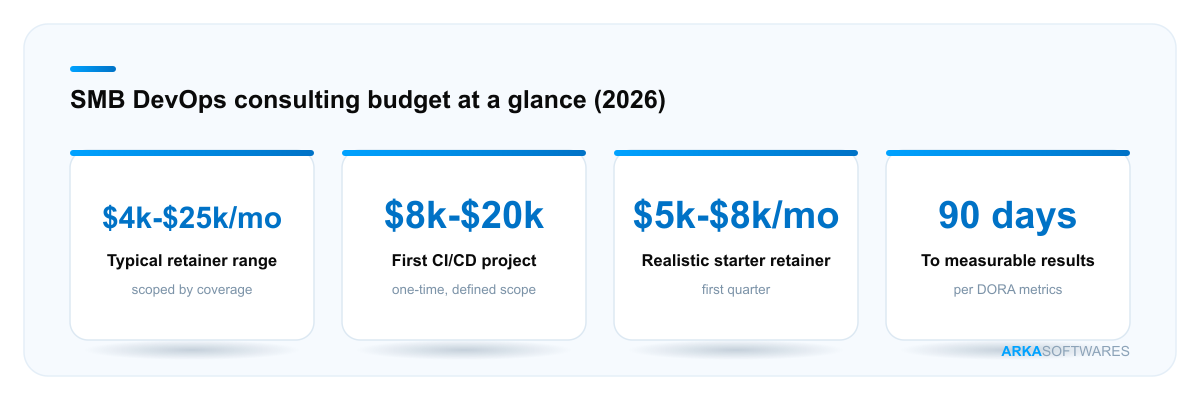
Here’s the honest answer: DevOps consulting for a small-to-mid-size company usually lands somewhere between $4,000 and $25,000 a month, depending on whether you need a one-time pipeline overhaul or an ongoing infrastructure partner. The wide range is the point — the pricing model you pick matters more than which DevOps consulting company you pick.
Quick answer: SMBs typically spend $4,000–$25,000/month on DevOps consulting. A short, defined project (like a first CI/CD pipeline) runs closer to $8,000–$20,000 total. Compliance work, multi-cloud setups, and 24/7 on-call support push costs toward the higher end.
One reason quotes feel higher than they did two years ago: demand. IMARC Group puts the global DevOps market at $15.8 billion in 2025, on track for $82.4 billion by 2034 — a 20% annual growth rate that has outpaced general IT services for years now. Engineers who can do this work well have options, and consulting rates reflect that.
There’s a useful buyer’s filter hiding in that number, though. In a seller’s market, a vendor who pads hours doesn’t need your business — but one who asks sharp questions about your actual infrastructure before quoting does. Strong demand punishes lazy scoping less than it should, so you have to do the punishing yourself.
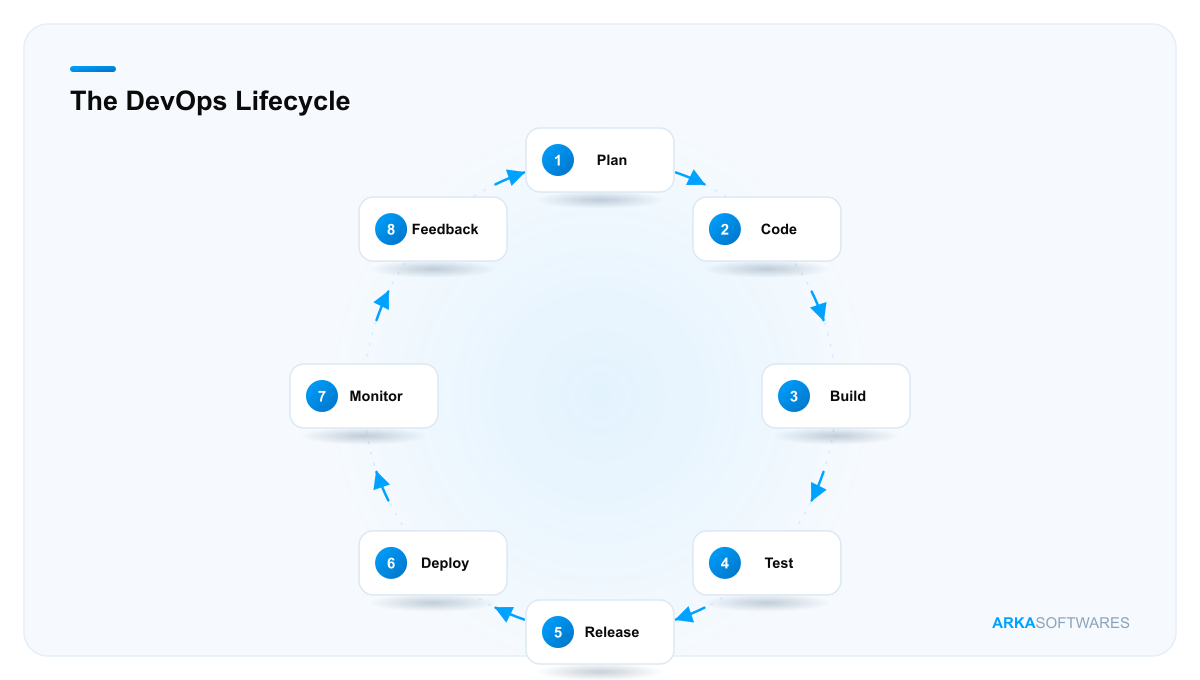
DevOps consulting isn’t one service. It usually breaks down into some combination of:
A vendor quoting a single number without telling you which of these is in scope is the first red flag. Ask for a line-item breakdown before you ask for a discount.
| Model | Typical cost | Typical timeline | Best for |
| Hourly / T&M | $50–$90/hr offshore, $120–$220/hr US-based | 1–3 weeks | A defined, short project — e.g. “set up our first CI/CD pipeline” |
| Monthly retainer | $4,000–$12,000/mo (part-time), $12,000–$25,000+/mo (near-full-time) | Ongoing, reviewed quarterly | Ongoing infrastructure ownership without a full in-house hire, similar to managed DevOps services |
| Fixed-scope project | $8,000–$60,000 depending on scope | 3–10 weeks | A bounded deliverable, like a cloud migration or a Kubernetes consulting engagement |
Treat these as planning estimates, not fixed market rates — final numbers depend on architecture complexity, compliance scope, and how fast you need someone to respond when something breaks.
For most SMBs still running on a single cloud account with fewer than 15 engineers, a part-time monthly retainer is the model that avoids both extremes: you’re not paying US enterprise rates for full-time coverage you don’t need yet, and you’re not stuck re-negotiating scope every time a new hourly task comes up. It’s also usually cheaper than trying to hire a DevOps engineer full-time before you actually have enough infrastructure work to justify one.
Four variables explain almost all the spread in quotes you’ll get:
Here’s where most SMBs actually overpay, though: not on the hourly rate, but on the cloud bill itself. During discovery calls, it’s common to find companies still paying for the instance sizes they provisioned at launch, sized for traffic they never hit, because nobody revisited the architecture once things stabilized. A decent consultant will flag that in week one. If your proposal doesn’t include a resource right-sizing pass, ask why not — it’s usually the fastest way an engagement pays for itself.
Worth a separate mention: if the scope includes any cloud infrastructure migration rather than just process/tooling work, that’s priced and scoped differently again — our cloud engineering team treats migrations as their own line item for exactly this reason.
Every firm packages this differently, but a well-run engagement follows the same five beats — and knowing them helps you spot a proposal that skips one.
One to two weeks reading your setup: cloud accounts, deploy process, incident history, existing tooling. This is where the right-sizing findings mentioned above surface. If a vendor quotes a full engagement price before doing this, the number is fiction — polite fiction, but fiction.
Scope, deliverables, timeline, and what’s explicitly out. A proposal sequenced like a product roadmap — phased, with decision points where you can stop — beats a flat block of hours every time.
The core weeks: CI/CD wiring, infrastructure as code, environment separation. Expect working increments weekly. A consultant who goes quiet for a month and promises a big reveal is running a waterfall project with your retainer.
A pipeline is only trustworthy once rollback and alerting are proven under fire, not just configured. Our quality engineering team treats this as its own phase for a reason — it’s the difference between a pipeline that exists and one your team actually trusts on a Friday afternoon.
Documentation, runbooks, and a genuine decision: your team owns it from here, or it rolls into ongoing support. A 60-to-90-day initial term should end with that choice truly open — that’s the test of whether the engagement was built around your outcome or their renewal.
Tooling varies by cloud and by what you already run, but this is the stack most SMB engagements standardize on. Treat it as a strong default, not gospel.
| Component | Recommended |
| Pipelines | GitHub Actions, GitLab CI, Jenkins (legacy estates) |
| Artifacts & registry | Docker, GitHub/GitLab registries, AWS ECR |
| Layer | Recommended |
| Provisioning | Terraform, Pulumi |
| Configuration | Ansible, cloud-native templates (CloudFormation/Bicep) |
| Layer | Recommended |
| Metrics & dashboards | Grafana, Prometheus, Datadog, CloudWatch |
| Logs & alerting | Loki/ELK, PagerDuty or Opsgenie for on-call routing |
| Containers & orchestration | Docker, Kubernetes (EKS/GKE/AKS) or ECS where simpler wins |
None of these tools change the pricing model — but a vendor proposing a tool outside this mainstream (or their own proprietary platform) should be able to explain exactly why, because proprietary tooling is a soft form of lock-in.
This is the other decision buried inside the pricing question. A consultant and a full-time hire aren’t interchangeable — they solve different problems:
| DevOps consultant | Full-time DevOps engineer | |
| Typical cost | $4,000–$25,000/month, scoped | $110,000–$170,000/year fully loaded (US), plus benefits and hiring cost |
| Ramp-up time | Days to weeks — brings existing playbooks | Weeks to months, including the hiring search itself |
| Best when | You need a defined outcome or don’t have full-time work to justify a hire yet | Infrastructure work is a permanent, growing part of the job, not a project |
Google Cloud’s own guidance on DevOps culture and automation makes a similar point: the practice matters more than who’s doing it, but somebody has to own it continuously once it exists — which is exactly the point at which most SMBs convert a consulting engagement into a full-time hire.
DevOps consulting tends to make sense when at least two of these are true:
If none of those apply yet, you probably don’t need a consulting engagement — you need one senior engineer for a few weeks, which is a very different (and cheaper) conversation.
Planning a cloud migration or a broader modernization project alongside this? It’s worth a scoping conversation before you commit to either engagement separately — ask us to walk through your current AWS, Azure, or GCP setup and flag where the quick wins actually are, before you sign anything long-term.
The DevOps research group behind the annual DORA State of DevOps research has tracked, for a decade now, that the highest-performing teams share four measurable habits: frequent small deployments, fast recovery from incidents, low change-failure rates, and short lead time from commit to production. A good consulting engagement should move at least two of those four numbers within the first 90 days — if a proposal doesn’t mention measuring any of them, ask why. AWS’s own overview of DevOps practices is a reasonable baseline if you want to sanity-check a vendor’s proposed scope against what the practice is supposed to cover in the first place.
We’ve written before about how dedicated teams compare to project-based outsourcing, and the same logic applies here — the right model depends on whether the work is a one-time deliverable or an ongoing capability gap. If you’re weighing this against a broader custom development spend, our software development pricing guide covers how these numbers stack up against a full build.
Skip the “passionate about excellence” boilerplate — here’s the checkable version of the pitch.
Arka’s DevOps consulting engagements run exactly the five-step shape above: a short discovery phase first, a line-itemed proposal second, and a 60-to-90-day initial term instead of a 12-month lock-in — because a vendor confident in their scoping doesn’t need your signature as insurance. Rates sit in the offshore band of the pricing table earlier, with the same team covering the adjacent work (cloud migration, quality engineering, ongoing support) when a project turns out to need more than pipelines.
If that model fits how you buy, the scoping call below is the fastest way to test it — and if it doesn’t, the checklist and red flags in this guide work just as well on whoever you do hire.
If you’re an SMB scoping this for the first time, a realistic starting budget is a part-time retainer in the $5,000–$8,000/month range for the first quarter, focused on CI/CD and observability basics, before deciding whether you need to scale up to compliance or multi-cloud work. That gets you a working pipeline and real visibility into your infrastructure without committing to a full-time-equivalent spend before you know if it’s needed.
One thing worth watching for in any proposal: a 12-month minimum commitment before you’ve seen a single deliverable. That’s backwards. A vendor confident in their scoping should be comfortable starting with a 60-to-90-day initial term, with the option (not obligation) to extend once you’ve actually seen the pipeline running.
DevOps consulting is one of the few budget lines that, done right, shrinks your other budget lines — the cloud bill, the incident hours, the deploy-day overtime. The numbers in this guide are the honest ranges; the pricing model you choose and the scoping discipline you demand will matter more than any of them.
Arka’s DevOps consulting team scopes engagements this way by default — a short discovery phase first, a line-itemed proposal second, so you’re not signing a retainer before you know what it covers. If you’d rather see how that fits alongside our other engineering services first, that overview covers what’s included at each tier. Otherwise, the fastest way to get an actual number instead of a range is to book a 20-minute scoping call — bring your current cloud bill and your last incident postmortem, and you’ll leave with a real estimate, not another range.
Offshore consultants typically run $50–$90/hr; US-based consultants run $120–$220/hr. Most SMBs end up on a monthly retainer instead of pure hourly billing once the engagement moves past a single short project.
It’s worth it once manual deploys, a slow-to-diagnose incident, or an unexplained cloud bill increase are already costing you real time — see the checklist above. Below that threshold, a short-term senior engineer is usually the cheaper, faster answer.
Yes, at the lower end of the retainer range ($4,000–$8,000/month, part-time), scoped narrowly to CI/CD and observability basics rather than full-scale compliance or multi-cloud work.
Most engagements combine CI/CD pipeline setup, infrastructure as code, observability/alerting, and a cost or security review — see the breakdown earlier in this guide for what each one actually involves.
A focused engagement should show measurable change — faster deploys, fewer failed changes, quicker incident recovery — within the first 90 days. If a proposal can’t tell you how it’ll measure that, that’s worth asking about before signing.


Jeeto11
The app quickly earned over 1,000 downloads within two months of launch, and users have responded positively. ARKA Softwares boasted experienced resources who were happy to share their knowledge with the internal team.

Archithrones
While the development is ongoing, the client is pleased with the work thus far, which has met expectations. ARKA Softwares puts the needs of the client first, remaining open to feedback on their work. Their team is adaptable, responsive, and hard-working.

Service Provider
I started my project with Arka Softwares because it is a reputed company. And when I started working with them for my project, I found out that they have everything essential for my work. The app is still under development and but quite confident and it will turn out to be the best.