Key Takeaways
There’s a moment every busy professional knows too well. Your housekeeper cancels at the last minute, guests are arriving in two hours, and the apartment is a disaster. A few years ago, you’d panic. Now? You open an app.
That shift — from stress to solution in under a minute — is exactly what apps like Pronto are built for.
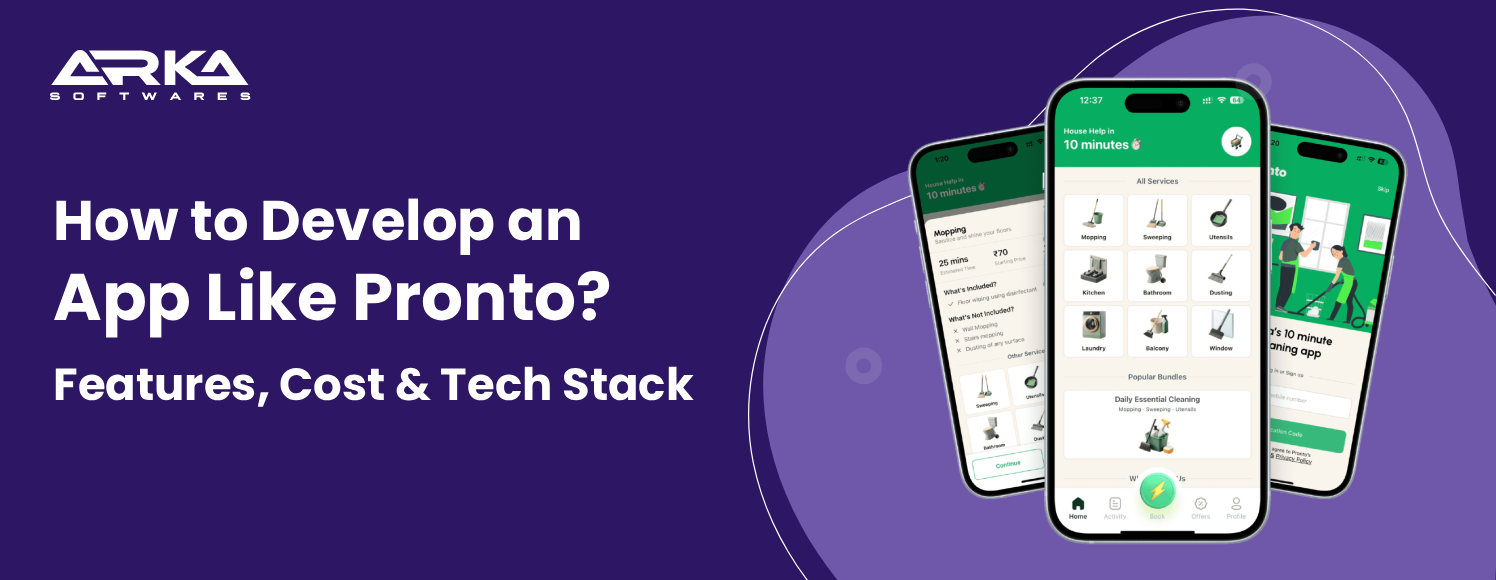
Pronto, developed by Swachh Saathi Inc., is an on-demand home services platform that puts professional house help at your door in 10 minutes or less. You pick your tasks, describe your home, and request help instantly, schedule it ahead, or set a recurring plan. No contracts. No hidden fees. Transparent pricing up front.
It’s simple on the surface. But building a platform like this — one that actually works at scale, handles real-time coordination, vets service partners, and keeps both sides of the marketplace happy — that’s a different story.
If you’re a startup founder or entrepreneur looking to build a home services app, this guide breaks down everything: the features you need, the technology that powers it, what it costs to build, and how you make money from it.
Let’s get into it.
Pronto is positioned as an on-demand marketplace for household services. Think of it as the Uber for home cleaning and household tasks — but with more flexibility in scheduling and a strong emphasis on safety.
Here’s the core flow:
The business model is a marketplace commission model. Pronto takes a cut from every booking. Service partners earn from completed jobs. Customers pay through the app using secure, transparent pricing.
What makes Pronto different from older home services platforms is the speed promise — 10 minutes for an instant booking — and the trust architecture.
Every service partner goes through vetting before being allowed onto the platform. That’s not a marketing bullet point; it’s an operational necessity. Without trust on both sides, a marketplace like this collapses.
This isn’t a trend born out of pandemic-era convenience. The demand for on-demand home services was building long before 2020, and it’s nowhere near peaking.
A few numbers worth paying attention to:
The underlying driver isn’t technology — it’s time scarcity. Dual-income households, urban professionals, and high-net-worth individuals are all paying more to buy back their hours. The app is just the infrastructure that makes that trade possible.
For startup founders, this creates a real opening. The market is large, fragmented, and still heavily reliant on informal, offline arrangements in most regions. A well-built platform with strong trust mechanisms and a smooth UX can win significant market share.
Building a home services marketplace means building three products at once. The customer experience, the service partner experience, and the backend operations layer all need to work together seamlessly.
Once a booking is confirmed, customers should be able to see exactly where their service partner is on a map. This isn’t a nice-to-have — it’s the single biggest driver of trust in on-demand apps. Pronto shipped this in version 1.2.7.
Flexibility here is non-negotiable. Some customers need help now. Others plan ahead. Many want a recurring arrangement that runs on autopilot. Build all three booking modes from day one.
Hidden fees kill retention. Show customers the full price — including any add-ons — before they confirm. Pronto’s App Store listing specifically calls this out as a feature.
Support multiple payment methods: card, wallet, UPI (for South Asian markets), and buy-now-pay-later options where relevant. Integrate payment gateways like Stripe, Razorpay, or PayTabs, depending on your target market.
Customers should be able to describe exactly what they need — number of rooms, type of tasks, any special requirements. The more context the platform captures, the better the matching.
After every booking, customers rate the professional and leave feedback. This feeds into the platform’s trust layer and helps surface the best service partners.
Booking confirmations, professional arrival alerts, payment receipts, promotional offers — all delivered via push. Done right, push notifications improve retention. Done wrong (too frequent, irrelevant), they kill it.
Customers need a way to communicate with their assigned professional before and during a booking. Keep it within the app — it protects both parties and keeps the transaction on-platform.
Let customers see their full booking history and re-book previous services with a single tap. Repeat bookings are your cheapest acquisition channel.
Service partners need a clean interface to accept, decline, or negotiate job requests. Include estimated earnings, location, and job details in each request notification.
Transparency on earnings builds loyalty among service partners. Show daily, weekly, and monthly breakdowns. Include pending payouts and completed transfers.
Integrate with Google Maps or Apple Maps so professionals get turn-by-turn directions to each booking. Reduce no-shows and late arrivals through better routing.
Let service partners set their working hours, block dates, and manage their schedule. Flexible scheduling attracts better talent to the platform
Build a digital onboarding flow: document upload, background check integration, and training module completion. The platform’s trust architecture lives here.
Show service partners their ratings and the specific feedback customers leave. It motivates quality and gives partners something to improve against.
A central dashboard showing all active, upcoming, and completed bookings. Ability to manually intervene, reassign professionals, or issue refunds.
Approve, suspend, or offboard professionals. Review their vetting documents. Monitor their ratings and service quality over time.
View customer profiles, booking history, lifetime value, and support tickets. Identify high-value customers and at-risk churners.
Revenue by service category, bookings by geography, peak demand hours, professional utilization rates — the operations team lives in this dashboard.
Set pricing rules by service type, city, zone, and time slot. Manage surge pricing during high-demand periods.
Create, track, and expire promotional codes and referral campaigns. Monitor acquisition cost per channel.
The platforms winning in this space today aren’t just better-designed. They’re smarter. AI sits underneath the features customers see and quietly makes everything work better.
When multiple bookings are clustered in a neighborhood, AI can assign them to nearby professionals to minimize travel time and maximize the number of jobs completed per hour. This directly improves unit economics.
Instead of showing a static “10 minutes” estimate, predictive ETA engines factor in live traffic, historical job completion times for that specific professional, and distance. Customers get accurate expectations, which reduces support tickets.
A well-trained chatbot handles the majority of common queries — booking status, cancellation policies, pricing questions — without human intervention. Reserve your support team for edge cases.
On marketplace platforms, fraud comes from both sides: fake bookings, manufactured reviews, payment disputes. Behavioral anomaly detection models can flag suspicious patterns before they become costly problems.
By analyzing historical booking data, weather patterns, and local events, AI can predict where demand will spike — allowing the platform to incentivize service partners to be available in those areas at the right time.
Over time, the platform learns each customer’s preferences — preferred professionals, service frequency, typical requests — and surfaces relevant recommendations. A customer who books cleaning every two weeks should see a recurring plan suggestion, not a generic home screen.
The tech decisions you make at the start of a build will shape how easily you can scale, add features, and fix issues two years from now. Here’s a practical, battle-tested stack for a home services platform at this scale:
| Layer | Technology Options | Notes |
|---|---|---|
| Frontend (iOS) | Swift, SwiftUI | Native performance is required for real-time tracking smoothness |
| Frontend (Android) | Kotlin, Jetpack Compose | Native Android; avoids hybrid app performance issues on low-end devices |
| Cross-Platform Option | React Native, Flutter | Good for MVPs; choose native for production scale |
| Backend | Node.js, Python (Django/FastAPI) | Node for real-time; Python for AI/ML integrations |
| Database (Primary) | PostgreSQL | Relational data: users, bookings, payments |
| Database (Real-Time) | Firebase Realtime DB / Redis | Live location tracking, chat |
| Cloud Infrastructure | AWS, Google Cloud Platform | Auto-scaling for demand spikes |
| CDN | AWS CloudFront, Cloudflare | Fast media delivery globally |
| Payment Gateways | Stripe (USA/UK), Razorpay (India), PayTabs (UAE) | Match gateway to market |
| Maps & Location | Google Maps API, Mapbox | Real-time tracking, routing, geocoding |
| Push Notifications | Firebase Cloud Messaging (FCM), APNs | Cross-platform push |
| In-App Chat | Twilio, SendBird, Stream | Production-grade messaging infrastructure |
| AI/ML | TensorFlow, PyTorch, scikit-learn | Demand forecasting, fraud detection |
| Background Checks API | Checkr, Onfido | Identity and background verification |
| Analytics | Mixpanel, Amplitude, AppsFlyer | User behavior tracking, attribution |
One architectural choice worth flagging early: microservices vs. monolith. For an MVP, start with a well-structured monolith.
It’s faster to build and easier to debug. Once you hit product-market fit and scale is a real concern, migrate specific high-load services (booking engine, tracking, notifications) to microservices. Don’t over-engineer early.
Most app development projects fail not because of bad technology, but because of skipped steps early in the process. Here’s what a proper build looks like:
Before writing a line of code, you need to understand your specific market. Which city or region are you launching in? What do existing home services look like (informal, agency-based, competitor apps)? Who are your early service partners? What price points are customers in this market comfortable with?
Talk to 20 potential customers. Talk to 10 potential service partners. The insights from these conversations will change your feature list.
Wire-framing, user flow design, high-fidelity mockups, and a clickable prototype. The goal of this phase isn’t to make something pretty — it’s to validate that customers can complete a booking flow without confusion and that service partners can accept a job in under 30 seconds.
Test the prototype with real users. Fix what’s broken before development starts.
Build the minimum set of features that allow you to take real bookings, coordinate professionals, process payments, and collect feedback. Cut anything that doesn’t directly serve one of those four functions.
For Pronto-style platforms, the MVP typically includes: customer booking flow (instant + scheduled), service partner app (job requests, navigation, earnings), admin panel (basic order management), payments, and ratings.
This runs in parallel with frontend development. Set up the database schema, REST/GraphQL API, real-time WebSocket connections for tracking and chat, and integrate third-party APIs (maps, payments, background checks, push notifications).
Functional testing across device types and OS versions. Load testing to ensure the booking engine handles concurrent requests. Security testing — especially for payment flows. Fix everything before launch, not after.
Apple’s review process takes 1–3 days for an initial submission. Google Play is faster. Have your app store listing, screenshots, privacy policy, and terms of service ready before submission.
The launch is not the finish line. Pronto’s changelog shows near-weekly updates through their first year — bug fixes, UX improvements, new features based on user feedback. Build a maintenance retainer into your budget from day one.
The honest answer is: it depends on where your development team is based, what features you’re building, and how polished the initial release needs to be.
| Region | Estimated Cost |
|---|---|
| USA / UK | $80,000 – $150,000 |
| UAE | $60,000 – $100,000 |
| India (via Arka Softwares) | $25,000 – $50,000 |
| Region | Estimated Cost |
|---|---|
| USA / UK | $150,000 – $300,000+ |
| UAE | $100,000 – $200,000 |
| India (via Arka Softwares) | $50,000 – $120,000 |
| Feature | Estimated Cost |
|---|---|
| Customer App (iOS + Android) | $12,000 – $25,000 |
| Service Partner App | $8,000 – $15,000 |
| Admin Dashboard | $6,000 – $12,000 |
| Real-Time Tracking | $4,000 – $8,000 |
| In-App Chat | $3,000 – $6,000 |
| Payment Integration | $2,000 – $5,000 |
| AI Route Optimization | $5,000 – $15,000 |
| Fraud Detection Module | $5,000 – $12,000 |
| Background Check Integration | $2,000 – $4,000 |
| Analytics Dashboard | $3,000 – $7,000 |
After launch, expect to spend $2,000 – $8,000/month on maintenance, depending on team size and update frequency. This covers bug fixes, OS compatibility updates, server infrastructure, and customer support tooling.
An app like Pronto has multiple, stackable revenue streams. You don’t have to pick one.
The most common approach for marketplace platforms. Pronto takes a percentage from every completed booking — typically 15–25%. Simple to understand, aligns platform incentives with transaction volume.
A flat convenience fee is added to each booking, separate from the service cost. Customers generally accept small fees ($1–3) if the product is reliable.
Offer customers a monthly membership that provides perks: priority booking, discounted rates, or access to premium professionals. This creates predictable recurring revenue and improves retention.
During high-demand periods (weekends, festivals, last-minute bookings), dynamically increase prices. Incentivizes service partners to be available and helps balance supply and demand.
Charge premium professionals a small fee for higher visibility in search results. This is common in marketplace models and adds a B2B revenue layer.
Partner with real estate developers, co-living spaces, or corporate housing providers to offer bundled services. White-label versions of the platform for property managers can open enterprise revenue.
Anyone telling you this is easy to build hasn’t shipped one. Here are the challenges worth understanding before you start:
Managing live location data, job assignments, and status updates for hundreds of concurrent bookings is technically demanding. The infrastructure needs to be designed for this from day one, not retrofitted later.
A marketplace where strangers enter homes has higher trust requirements than most consumer apps. Vetting processes, background checks, in-app safety features, and transparent review systems all need to work together. If one fails, the whole trust architecture cracks.
Getting enough trained, reliable service partners in each city you launch is an ongoing operational challenge. Under-supply means long wait times. Oversupply means partners don’t earn enough to stay active on the platform. Balancing this requires constant attention.
You’re running two businesses simultaneously: a consumer product and a workforce product. Both need separate retention strategies. What keeps a customer coming back (reliability, quality, pricing) is different from what keeps a service partner active (fair earnings, steady work, responsive support).
What works in one city may not work in three. The booking logic, pricing engine, partner vetting, and support systems all need to be designed for geographic expansion from the start.

As a leading Home Services App Development Company, we’ve built on-demand service platforms for clients across the USA, UAE, UK, Canada, and Australia. Not prototypes — production applications that handle real users and real transactions.
Here’s what that experience looks like in practice:
We’ve designed the booking engines, real-time tracking layers, and multi-panel dashboards that make platforms like Pronto work at scale. We know where the technical landmines are, because we’ve stepped on a few of them for earlier clients, so you don’t have to.
Our AI/ML team builds demand forecasting, route optimization, and fraud detection as native parts of the platform — not bolt-on features added as an afterthought. This matters enormously for unit economics as you scale.
Consumer apps live or die on the first impression. Our design team builds flows that reduce friction at every stage — from the first booking to the 50th. Lower drop-off in the booking flow means more completed transactions.
Every platform we build is architected for scale. Auto-scaling, microservices where appropriate, and infrastructure-as-code so your DevOps team can manage it independently.
We don’t disappear after the app ships. Our retainer clients get ongoing maintenance, performance monitoring, feature development, and direct access to the engineering team that built the product.
Whether you’re a funded startup in Dubai or a bootstrapped founder in Toronto, we give you a fixed-scope proposal with no surprise overruns. You know what you’re getting before you commit.
The opportunity in on-demand home services is real, the market is large, and the infrastructure to build a platform like Pronto is accessible. But the gap between a working app and a successful business is where most startups underestimate the work.
The technology is the easy part. The hard part is building trust on both sides of the marketplace, managing supply and demand across geographies, and iterating fast enough to stay ahead of user expectations.
What separates the platforms that scale from the ones that stall is rarely the feature list. It’s the quality of the execution — the booking flow that just works, the tracking that’s actually accurate, the professional who shows up on time and does a great job.
If you’re serious about building in this space, the first step isn’t choosing a tech stack. It’s talking to your future users — both customers and service partners — and understanding what they actually need.
After that, Arka Softwares can help you build it.
The cost depends on your feature scope and development team location. An MVP typically runs between $25,000 and $60,000 with an Indian development team like Arka Softwares. A full-featured version with AI capabilities can cost between $50,000 and $120,000. US and UK-based teams will cost significantly more for the same output.
An MVP covering customer app, service partner app, and admin panel — takes approximately 4–6 months from kickoff to App Store launch. This includes design, development, QA, and submission. A more feature-rich version with AI integration typically takes 7–10 months.
Not necessarily. For an MVP, you can launch with manual dispatching, basic tracking, and rule-based pricing. But plan your architecture to accommodate AI features later — demand forecasting, route optimization, and fraud detection all become important as you scale past a few hundred bookings per day.


Jeeto11
The app quickly earned over 1,000 downloads within two months of launch, and users have responded positively. ARKA Softwares boasted experienced resources who were happy to share their knowledge with the internal team.

Archithrones
While the development is ongoing, the client is pleased with the work thus far, which has met expectations. ARKA Softwares puts the needs of the client first, remaining open to feedback on their work. Their team is adaptable, responsive, and hard-working.

Service Provider
I started my project with Arka Softwares because it is a reputed company. And when I started working with them for my project, I found out that they have everything essential for my work. The app is still under development and but quite confident and it will turn out to be the best.