Key Takeaways:
Most app ideas start with a frustration.
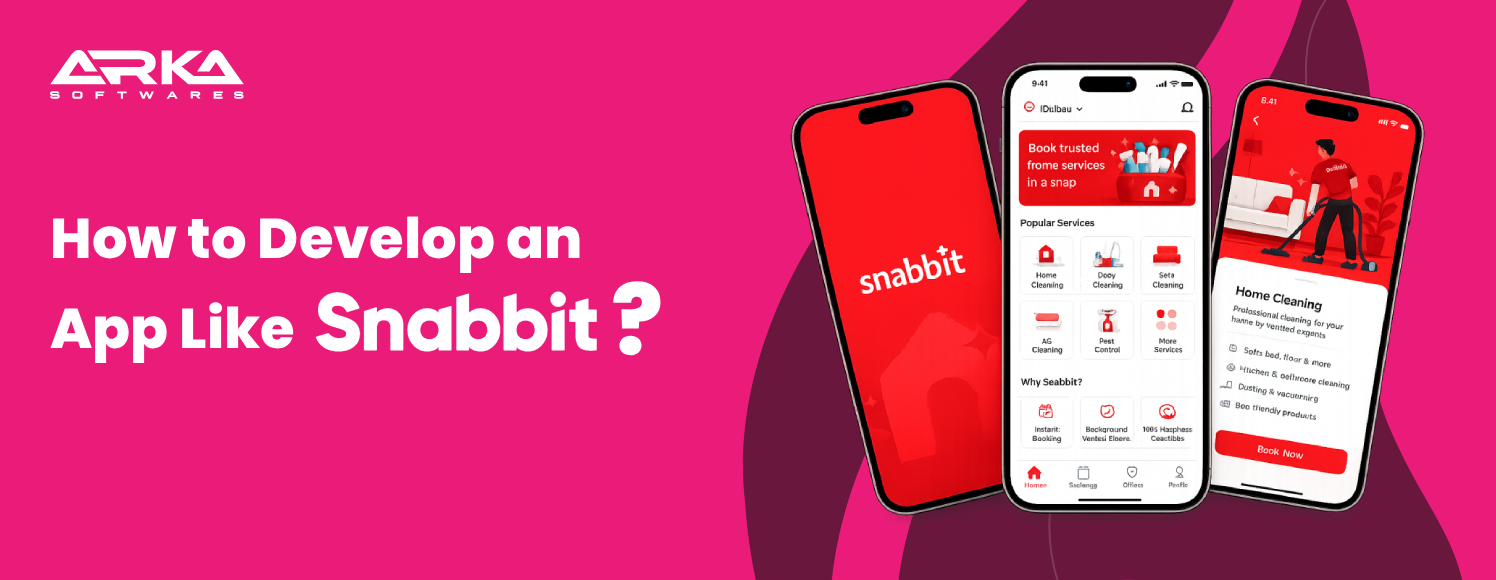
Someone needed reliable house help, couldn’t find it fast enough, and thought, there has to be a better way. That’s exactly the problem Snabbit set out to solve.
Founded in 2024, it does something deceptively simple: connect users with verified, trained female house help in under 10 minutes.
No calls, no waiting, no uncertainty. Just someone at your door ready to handle the cleaning, dishes, or laundry faster than most food delivery apps can confirm your order.
And it worked. Because the problem was real, the solution was focused, and the execution was tight.
If you are thinking about building an app like Snibbet, you are not chasing a trend. You are solving a real, daily, revenue-draining problem for an industry that is growing fast and digitising slowly.
Here’s the thing though, what you see when you open Snabbit is the polished surface of a lot of invisible decisions. The 10-minute matching isn’t magic; it’s the result of smart backend logic, real-time availability tracking, hyperlocal supply management, and a worker onboarding system that actually maintains quality at speed. Strip any one of those out, and the whole promise falls apart.
That’s what most “how to build an app” guides miss. They’ll walk you through screens and features. They won’t tell you that your matching algorithm needs to account for proximity, task type, and worker availability simultaneously or that your trust layer (background checks, training verification, ratings) is arguably more important than your UI.
This guide covers how Snibbet works, which features matter and why, the build process, honest cost ranges, and where most projects go sideways before they ever launch.
Whether you’re a founder sketching your first pitch deck, a product manager scoping the real effort, or a dev team trying to estimate the build accurately by the end of this, you’ll know exactly what you’re getting into before you write a single line of code.
Here is what the data actually tells you about the size and direction of this opportunity.
Snibbet is a beauty marketplace app that connects clients with local beauty professionals, stylists, nail technicians, estheticians, and barbers for discovery, booking, and payment in one place.
The user flow is clean: search by service or location, browse provider profiles with photos and reviews, pick an available slot, pay in-app, and show up. The provider gets notified, confirms, and delivers the service.
What makes Snibbet-style apps genuinely hard to build is that you are essentially building three separate products that share the same data layer: a consumer booking app, a business management tool for service providers, and a platform control panel for the operator.
Each has different users, different workflows, and different success metrics. Getting all three right and keeping them in sync is where most home services projects stall.
Think about the last time you needed a plumber on short notice. You probably didn’t flip through a directory or ask a neighbor. You grabbed your phone.
That instinct to reach for the app is exactly why this industry is growing at a pace that’s hard to ignore.
Nobody wants to call three different electricians, wait two days for a callback, and then haggle over pricing. Apps killed that whole process.
You open it, pick a time, see the price upfront, and track the professional on their way. It’s the same expectation Uber and Zomato created, and now it’s the baseline for home services too.
Urban life doesn’t leave much room for chasing handymen. In most dual-income households, weekends are already packed the last thing anyone wants to spend Saturday doing is fixing a leaking pipe they barely know how to identify. Outsourcing home tasks stopped being a luxury somewhere around 2020. Now it’s just how things get done.
The old way of hiring home help was basically word of mouth and hope. These apps changed that. Background checks, verified reviews, service guarantees, real ratings from real customers suddenly you’re not rolling the dice every time you let someone into your house. That shift in confidence is a big reason adoption took off.
Smartphone penetration exploded, and not just in metros. Tier-2 and tier-3 cities are now online in a big way, which means the addressable market for these platforms grew far beyond what early projections assumed. More users, more cities, more demand follows.
Supply kept pace with demand which isn’t always how it goes. The gig economy gave workers a real alternative to traditional employment, and home services platforms became a serious income source. More providers on the platform means shorter wait times, better coverage, and prices that stay competitive. Both sides of the marketplace grew together.
Early versions were just booking tools. Now they’re using AI to schedule around your preferences, flag when your AC filter is probably due for a change, and suggest the right service before you even know you need it. That kind of experience keeps people coming back not because they have to, but because it actually works.
Here’s the real reason behind all of this: home services apps don’t just offer convenience. They solve a problem that people run into constantly, with a solution that’s genuinely better than what came before. That’s a rare combination and it’s why the growth curve hasn’t flattened yet.
Each feature below is listed with exactly what it does no padding, no vague explanations.
| Feature | What It Does |
| Smart search and filters | Lets users find providers by service, price, rating, location, and availability with fuzzy matching for misspellings and service name variations. |
| Provider profiles and portfolios | Shows photo galleries of real work, service menus with pricing, verified reviews, and response rate data so users can choose with confidence. |
| Real-time availability calendar | Displays live open slots synced directly to the provider’s schedule — no stale data, no double bookings. |
| In-app booking | Lets users reserve a slot in seconds without calls, DMs, or waiting on hold. |
| Secure payment processing | Handles card payments, deposits, tips, and refunds using Stripe for US and UK markets, Checkout.com or PayFort for UAE and MENA. |
| Booking history and receipts | Gives users a clear record of past and upcoming appointments with one-tap rebooking for regular services. |
| Reviews and ratings | Allows verified clients to rate and review providers after every completed service, keeping feedback trustworthy and manipulation-resistant. |
| Push notifications | Sends booking confirmations, 24-hour reminders, and post-service review prompts without bombarding users with unnecessary alerts. |
| Loyalty and referral system | Rewards repeat clients with credits and gives users an incentive to bring new customers onto the platform. |
| In-app chat | Lets clients message their provider directly for pre-appointment questions or last-minute changes without leaving the app. |
| Feature | What It Does |
| Schedule management | Lets providers set working hours, block personal time, and manage recurring or one-off availability directly from their phone. |
| Booking management | Allows providers to accept, decline, reschedule, or mark no-shows in a few taps with no complex interface to navigate. |
| Client history and notes | Stores past service records, preferences, allergies, and contact details for every returning client to personalise repeat visits. |
| Earnings dashboard | Shows completed bookings, pending payouts, platform fees deducted, and projected income in one clear, readable view. |
| Promotion tools | Lets providers create limited-time offers, new client discounts, or service bundles independently without needing admin approval. |
| Profile and portfolio editor | Allows providers to update their photos, services, pricing, and bio directly from the app at any time. |
| Reviews received | Shows all client feedback in one place so providers can monitor reputation and spot patterns in what clients love or flag. |
| Notification controls | Lets providers set exactly how and when they receive booking alerts, cancellations, and reminders to avoid disrupting services. |
| Feature | What It Does |
| User and provider management | Handles onboarding, ID verification, license checks, and account suspension with full audit trails for every action. |
| Booking oversight | Gives admins visibility into all active and past bookings to resolve disputes and monitor service quality across the platform. |
| Commission and payout controls | Manages fee structures, payout schedules, and custom commission rates by service category or geography. |
| Dispute and refund management | Processes escalated booking issues, refunds, and chargebacks through a structured review workflow with documented evidence. |
| Platform analytics | Tracks booking volume, revenue by geography, provider performance, and user retention by cohort to drive growth decisions. |
| Content and category management | Lets admins add or edit service categories, pricing ranges, and featured placements without involving a developer. |
| Promotions and coupons | Creates and manages platform-wide discount campaigns or targeted offers for specific user segments at any time. |
| Feature | What It Does |
| Personalised recommendations | Surfaces providers and services based on a user’s booking history, style preferences, and browsing behaviour to increase conversion. |
| Smart scheduling | Identifies gaps in provider calendars and targets high-intent users with available slot nudges at the right moment to fill empty time. |
| Dynamic pricing suggestions | Prompts providers to offer off-peak discounts to fill slow hours — opt-in, always shown transparently to the user. |
| AI chatbot support | Handles common queries like cancellation policies, payment issues, and review requests without routing every question to a human agent. |
| Fraud and review integrity detection | Flags fake reviews, payment anomalies, and rating manipulation before they damage platform trust at scale. |
| Predictive no-show alerts | Identifies high-cancellation-risk bookings based on behaviour patterns and triggers pre-emptive confirmation nudges automatically. |
Nail down your geography and niche before writing a single line of code. Map your competitors, define your user personas, and document the exact daily workflows your provider side needs to manage.
Skipping this step is the most expensive mistake in app development teams that rush past discovery, spend months fixing decisions that should have taken days.
Separate what is MVP from what is roadmap before development starts. Pick five to eight core flows, build them well, and ship. Every feature added to the first version adds delay and risk. Real users will tell you what to build next; save the feature ideas for version two.
Design the consumer app first, the provider panel second, and the admin panel third. Consumer UX drives adoption. Provider UX drives supply retention. Admin UX drives operational efficiency. All three need design attention, just not in equal measure at launch.
This is the hardest part of the build: booking logic, real-time calendar sync, payment processing, notification infrastructure, and the data architecture that ties all three panels together. Budget at least ten weeks of backend work for a solid MVP-level feature set.
React Native or Flutter for cross-platform. Swift and Kotlin for native. You will typically build three apps sharing one backend: a consumer for iOS and Android, a provider, and an admin web panel. Cross-platform saves 30 to 40% in build time with minor performance trade-offs at edge cases.
Run functional, load, and payment flow tests before anything goes to production. One bug in a transaction flow causes real user harm not just a bad review. A third-party security audit is non-negotiable before launch, especially for apps handling payments and personal data.
Release to a small, defined cohort in one city. Collect real booking data, provider feedback, and support ticket patterns. Fix the top three pain points before you consider expanding to a second market. Every issue caught at beta costs a fraction of what it costs post-scale.
Add markets, add features, and optimise based on actual usage data. The home services app market value is between $4 billion and over $600 billion in 2024–2025, depending on the scope.
The sector is projected to grow at a CAGR between 8% and 16.7% through 2030–2033. There is a long runway for platforms that get the fundamentals right before they scale.
No single stack is universally right. This one scales predictably for this type of application, and experienced teams can execute it without surprises.
| Layer | Technology |
| Mobile — cross-platform | React Native, Flutter |
| Mobile — native | Swift (iOS), Kotlin (Android) |
| Backend | Node.js, Python (Django / FastAPI) |
| Database | PostgreSQL (relational), MongoDB (flexible content) |
| Real-time | Socket.io, Firebase Realtime Database |
| Payments | Stripe (US/UK/EU), Checkout.com / PayFort (UAE/MENA) |
| Maps and geolocation | Google Maps API, Mapbox |
| Push notifications | Firebase Cloud Messaging (FCM), APNs |
| AI and ML | TensorFlow, OpenAI API, custom Python recommendation models |
| Cloud infrastructure | AWS, Google Cloud, or Azure |
| CDN | Cloudflare |
| DevOps | Docker, Kubernetes, CI/CD via GitHub Actions |
A practical note on AI integration: connecting an LLM API takes a week. Tuning it to give genuinely useful responses instead of generically plausible ones takes months. Build that tuning time into your project plan, not your marketing announcement.
Scope drives cost more than anything else. Here are honest, realistic ranges.
| Development Scope | Estimated Cost | Timeline |
| MVP: core booking, 2 panels | $35,000 – $65,000 | 4 – 6 months |
| Mid-tier: 3 panels, payments, basic AI | $65,000 – $120,000 | 7 – 10 months |
| Full platform: all features, multi-market | $120,000 – $180,000+ | 10 – 14 months |
What pushes the number up:
1. No providers at launch: Recruit providers in one geography before you open to consumers, and offer early-adopter incentives: lower commission rates, free premium placement, or guaranteed minimum bookings.
2. Stale availability data: Make schedule management so frictionless that updating it takes less effort than ignoring it this is a UX problem, not just a technical one.
3. No-shows and cancellations: Collect deposits at booking, enforce cancellation windows with clear policies, and use predictive alerts to confirm high-risk appointments before they become losses.
4. Trust and verification: Build a lightweight verification workflow that checks licenses and IDs without making onboarding so painful that providers abandon it halfway through.
5. Payment disputes: Document services at the point of booking require post-service confirmation before releasing funds, and have a structured dispute review process in place before you need it.
Building a two-sided marketplace is not a template project. The architecture decisions you make in month two directly affect how the platform performs in year two.
Arka Softwares brings direct experience in real-time booking systems, multi-region payment integration, and the provider-facing UX challenges specific to service marketplace apps. Our teams have delivered platforms for clients across the US, UAE, UK, and Southeast Asia in healthcare, logistics, retail, and professional services.
What that means practically:
If you are evaluating development partners, ask specifically about a two-sided marketplace experience. General mobile development experience does not automatically transfer to the booking logic, commission accounting, and availability sync complexity that apps like Snibbet require.
Arka Softwares is a reliable mobile app development company specialising in on-demand service platforms, marketplace applications, and AI-powered mobile products for startups and growth-stage companies across the US, UAE, UK, and globally.
A focused MVP takes 2 to 3 months. A full-featured platform with AI capabilities, three panels, and multi-market support typically takes 3 to 6 months.
The cost to develop an app like Snabbit ranges between $15,000 for a lean MVP and $50,000 or more for a full platform. The biggest variables are team location, native vs. cross-platform mobile, and AI feature depth. Budget 20% of the initial development cost annually for maintenance.
Yes. Their workflows are different enough that one app serving both creates a poor experience for both. They share a backend but need separate front-end interfaces.
Personalised recommendations and smart scheduling have the clearest impact on booking conversion and provider calendar utilisation. Chatbot support reduces operational cost at scale. Fraud detection protects platform trust before it becomes visible.


Jeeto11
The app quickly earned over 1,000 downloads within two months of launch, and users have responded positively. ARKA Softwares boasted experienced resources who were happy to share their knowledge with the internal team.

Archithrones
While the development is ongoing, the client is pleased with the work thus far, which has met expectations. ARKA Softwares puts the needs of the client first, remaining open to feedback on their work. Their team is adaptable, responsive, and hard-working.

Service Provider
I started my project with Arka Softwares because it is a reputed company. And when I started working with them for my project, I found out that they have everything essential for my work. The app is still under development and but quite confident and it will turn out to be the best.